Scale Faster With Pixel and CAPI: Three Campaign Facebook Ads Funnel
A Facebook ads funnel is a set of connected campaigns that move a stranger from first impression to paying customer, each one built around a single job. My default for ecommerce is a three-campaign structure, top of funnel, middle of funnel, bottom of funnel, with strict audience exclusions between them and both Meta Pixel and Conversions API firing on every event. Skip a stage or merge jobs into one campaign, and the algorithm gets confused about what “success” means. The build steps are below.
TL;DR:
- Separating campaigns into distinct stages with dedicated goals and exclusions prevents algorithm confusion and ensures each funnel stage is properly optimized.
- For accounts spending under $2,000 to $3,000 monthly, combining MOFU and BOFU into one retargeting campaign and running a single prospecting campaign for TOFU can accelerate learning.
- Creative testing should include 8 or more fresh assets per month, tailored to each funnel stage, with clear metrics like hook rate and frequency indicating fatigue or underperformance.
- Running both Pixel and Conversions API together with proper event_id deduplication improves conversion accuracy and trustworthiness of data.
- Budget allocation depends on brand maturity, with new brands prioritizing prospecting, while established brands can allocate more towards retargeting and repeat-purchase campaigns.
Table of Contents
- What Is a Facebook Ads Funnel, and When Do You Actually Need One?
- TOFU, MOFU, and BOFU: Objectives, Audiences, Creative, and KPIs for Each Stage
- How to Build the Funnel in Ads Manager
- Creative Strategy and Testing: What Powers the Funnel
- Tracking, Attribution, and Measurement That You Can Actually Trust
- Budget Allocation: How Much Goes to Each Stage
- Common Mistakes and a 6-Week Troubleshooting Checklist
- My Practical Notes and Lessons Learned Running Funnels for Ecommerce Brands
- How My Team at Cosma Can Help You Build or Fix Your Funnel
- Sources
- FAQ
What Is a Facebook Ads Funnel, and When Do You Actually Need One?
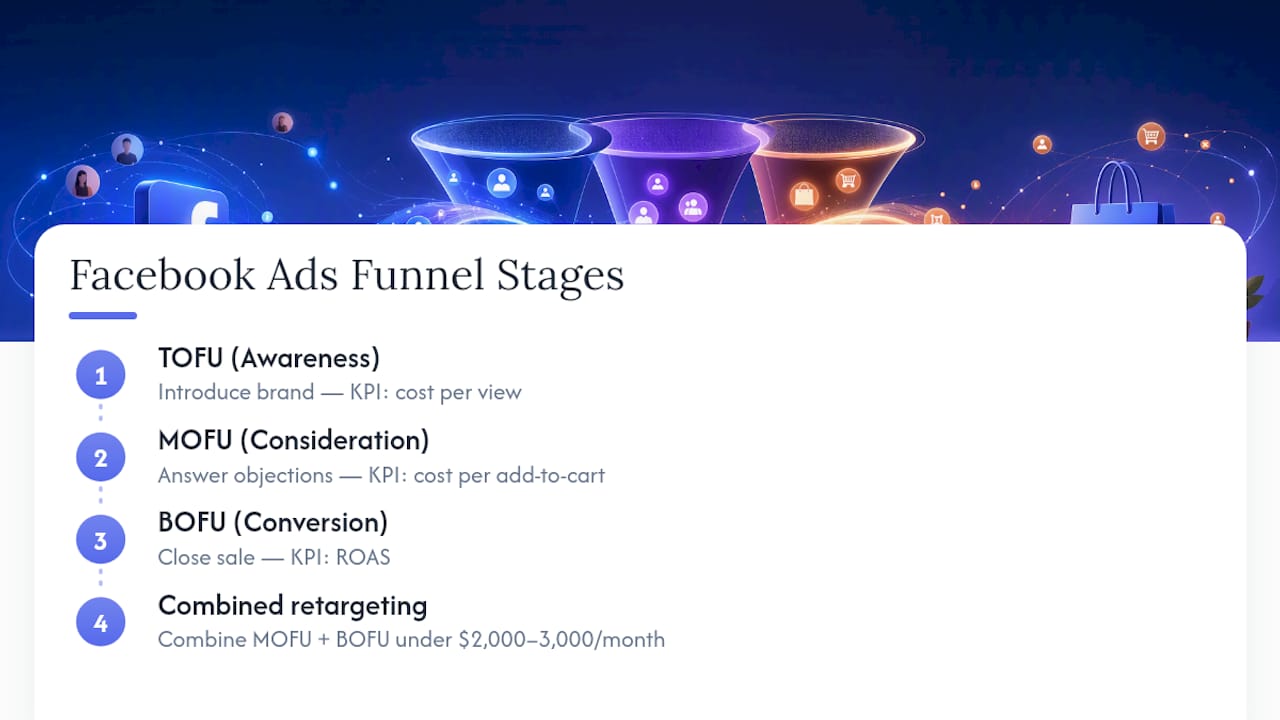
A Facebook ads funnel maps each campaign to one job in the buying journey: awareness, consideration, or conversion. Cold traffic sees a campaign built to introduce the brand. People who engaged but didn’t buy see a different campaign built to answer objections. People who added to cart but bailed see a campaign built to close the sale. Each stage gets its own objective, its own creative, and its own success metric.
The reason this matters comes down to how Meta’s delivery system works. When you dump prospecting and retargeting into a single ad set, the algorithm receives conflicting signals about whom to show ads to. It sees conversions from warm, already-familiar shoppers mixed in with impressions on cold strangers, and it starts optimizing toward the easy wins, meaning it quietly starves your top-of-funnel reach in favor of people who were close to buying anyway. You end up with a campaign that looks efficient on paper while your pipeline of new customers dries up.
A clean three-stage funnel with exclusions between each layer prevents that cannibalization. Each campaign becomes accountable to one number: TOFU owns cost per landing page view or video watch time, MOFU owns cost per add-to-cart, BOFU owns return on ad spend. Nobody argues about whether a campaign “worked” when the KPI was defined before launch.
Full separation isn’t always the right call on day one, though. If you’re running under $2,000 to $3,000 a month, splitting into three campaigns often starves each one of enough volume to leave the learning phase. In that case, I run a single prospecting campaign for TOFU and combine MOFU and BOFU into one retargeting campaign until the warm pool grows large enough to justify a split. That’s a deliberate compression, not a shortcut, and I’ll cover exactly when to make that call in the budgeting section below.
The mistake I see most often isn’t under-splitting. It’s brands running five or six ad sets that all claim to be “conversion campaigns” with no defined stage at all. That’s not a funnel. That’s just spend with no hierarchy behind it.
TOFU, MOFU, and BOFU: Objectives, Audiences, Creative, and KPIs for Each Stage
Each stage of a Facebook ad conversion funnel has a distinct job, and treating them identically is the single fastest way to waste budget. Here’s how I structure each layer for ecommerce accounts.
Top of funnel: earning attention from strangers
TOFU exists to introduce your brand to people who have never heard of you and generate enough engagement data for Meta to build a lookalike profile. The objective should almost always be set to maximize reach, video views, or landing page views, depending on account maturity, not purchases. Asking Meta to optimize for purchases on a completely cold audience with thin pixel data usually backfires, since the system has nothing to learn from yet.
Audience seeds for TOFU:
- Broad interest or Advantage+ audience targeting with minimal restriction
- Lookalikes built from your best existing customers (1% to 3%, if list size supports it)
- Broad, unrestricted “open” targeting once your pixel has enough signal volume
Creative that works at this stage:
- Short-form video (under 15 seconds) built for the hook, not the pitch
- UGC-style content that doesn’t look like an ad in the first three seconds
- Problem-agitation content that names a pain point before naming the product
KPIs to watch: hook rate (3-second video views divided by impressions), cost per landing page view, and thumb-stop ratio. Ignore ROAS here entirely. If you’re killing top-of-funnel ads because they don’t show direct purchases, you’re judging a discovery channel by a closing metric, and you’ll starve the exact audience that feeds your retargeting pools two weeks later.
Middle of funnel: answering objections
MOFU targets people who engaged with TOFU content, watched a threshold percentage of video, visited the site, or interacted on Instagram or Facebook, but didn’t convert. This is where objection-handling creative does the heavy lifting: testimonials, comparison content, founder-explainer videos, and social proof that a cold stranger wouldn’t sit through but a warmed lead will.
Standard MOFU audience windows run 7 to 14 days for site visitors and video viewers, and 14 to 30 days for page engagers, since engagement signals decay slower than site visits. The ad format that consistently outperforms static images here is customer testimonial UGC, ideally unscripted, paired with a specific before-and-after claim.
KPIs to watch: cost per add-to-cart, click-through rate, and checkout initiation rate. If add-to-cart cost is climbing while TOFU cost per landing page view stays flat, the objection-handling creative is the first thing to check, not the targeting.
Bottom of funnel: closing the sale
BOFU exists for one purpose: converting people who showed real purchase intent but didn’t finish. That’s cart abandoners, checkout initiators, and product-page viewers within a short, recent window, usually 3 to 7 days for the hottest segments.
Dynamic product ads that show the exact item someone viewed, paired with a specific offer (free shipping threshold, limited-time discount, bundle upsell) outperform generic retargeting creative by a wide margin in my accounts. Frequency needs closer monitoring here than anywhere else in the funnel. Anything above 3 to 4 impressions per person per week on a small BOFU pool usually signals fatigue, not persistence paying off.
KPIs to watch: ROAS, cost per purchase, and frequency. This is the only stage where I’ll accept a heavier frequency cap because intent is already established, but I still cap it.
Exclusions that keep the funnel honest
The exclusion logic between stages is what makes the whole structure work instead of just looking organized on paper:
- Exclude all past purchasers (30, 60, or 90-day windows depending on repurchase cycle) from TOFU and MOFU entirely.
- Exclude MOFU engagers from the TOFU audience once they’ve entered the MOFU pool, so they don’t get double-counted or double-served.
- Exclude BOFU cart abandoners from MOFU once they’ve moved into the hottest retargeting segment.
- Refresh exclusion lists weekly, since stale lists let people bleed across stages and confuse attribution.
How to Build the Funnel in Ads Manager
This is the actual sequence I use to stand up a new funnel from scratch, whether it’s a brand-new ad account or a rebuild of a messy one.
- Create three separate campaigns, named by stage and objective for fast auditing later, something like “TOF | Prospecting | Video Views” and “BOF | Retargeting | Purchase.” Sloppy naming is the number one reason audits take three times longer than they should.
- Set campaign objectives to match the stage job: TOFU on engagement, video views, or traffic; MOFU on traffic or add-to-cart if volume supports it; BOFU always on purchase conversion.
- Size your starter budget around learning-phase volume, not around what feels comfortable to spend. Meta’s practical target is roughly 50 optimization events per week per ad set to exit the learning phase reliably. If your average order value implies you’ll get 10 purchases a week at your planned budget, you don’t have enough volume to run purchase-optimized campaigns yet, so either raise the budget, consolidate ad sets, or optimize for a higher-funnel event temporarily.
- Build your custom audiences before you build ad sets. Pull site visitors segmented by page depth and recency, video viewers segmented by watch percentage, and page or Instagram engagers segmented by engagement type. These become your MOFU and BOFU sources.
- Build lookalikes from your highest-value segments, not just “all purchasers.” A lookalike built from customers with above-average order value or repeat purchases usually outperforms a lookalike built from every one-time buyer.
- Layer in exclusions at the ad set level immediately, not after launch. Retrofitting exclusions into a campaign that’s already spending is how overlap creeps in and never gets fixed.
- Decide between Advantage+ and manual campaign separation based on account maturity, not convenience. Advantage+ shopping campaigns work well once you have enough historical conversion data for Meta’s automation to have something to learn from, generally after your account has cleared the 50-events-per-week threshold consistently for a few weeks. Before that, manual separation gives you the control to diagnose problems that Advantage+'s black-box delivery makes harder to isolate.
- Launch with two to three creative concepts per ad set minimum, never a single ad. One ad tells you nothing about whether the concept or the specific execution is what’s underperforming.
Pro Tip: Before you touch budgets or targeting, audit your exclusion lists first. I’ve seen more wasted spend from a MOFU audience that secretly included BOFU converters than from any targeting mistake. Overlap is invisible until you go looking for it.
On the Advantage+ question specifically: I lean manual for brands under 100 monthly conversions because I need to see exactly which audience and creative combination is driving results. Once an account has stable, high-volume conversion data, Advantage+ campaigns can outperform manual structures because Meta’s system has more signal to work with than any human targeting guess. The trade-off is diagnostic visibility, and for a brand still figuring out its offer and creative angles, that visibility is worth more than the automation.
Creative Strategy and Testing: What Powers the Funnel
Creative is targeting now. Meta’s delivery system reads engagement signals off your creative, hook rate, watch time, click behavior, and uses those signals to decide who else to show the ad to. A weak creative with perfect audience settings will underperform a strong creative with loose settings almost every time, which is why creative testing deserves the same rigor as audience structure.
The testing matrix I run monthly looks like this: pick 4 to 6 distinct angles (a problem-agitation angle, a social-proof angle, a founder-story angle, a comparison angle, an urgency angle, a feature-education angle). Then produce each angle in 3 formats, typically a UGC talking-head video, a static image with bold text overlay, and a short montage or demo clip. That gives you 12 to 18 discrete creative tests per month without diluting budget across dozens of micro-variants that never reach significance.
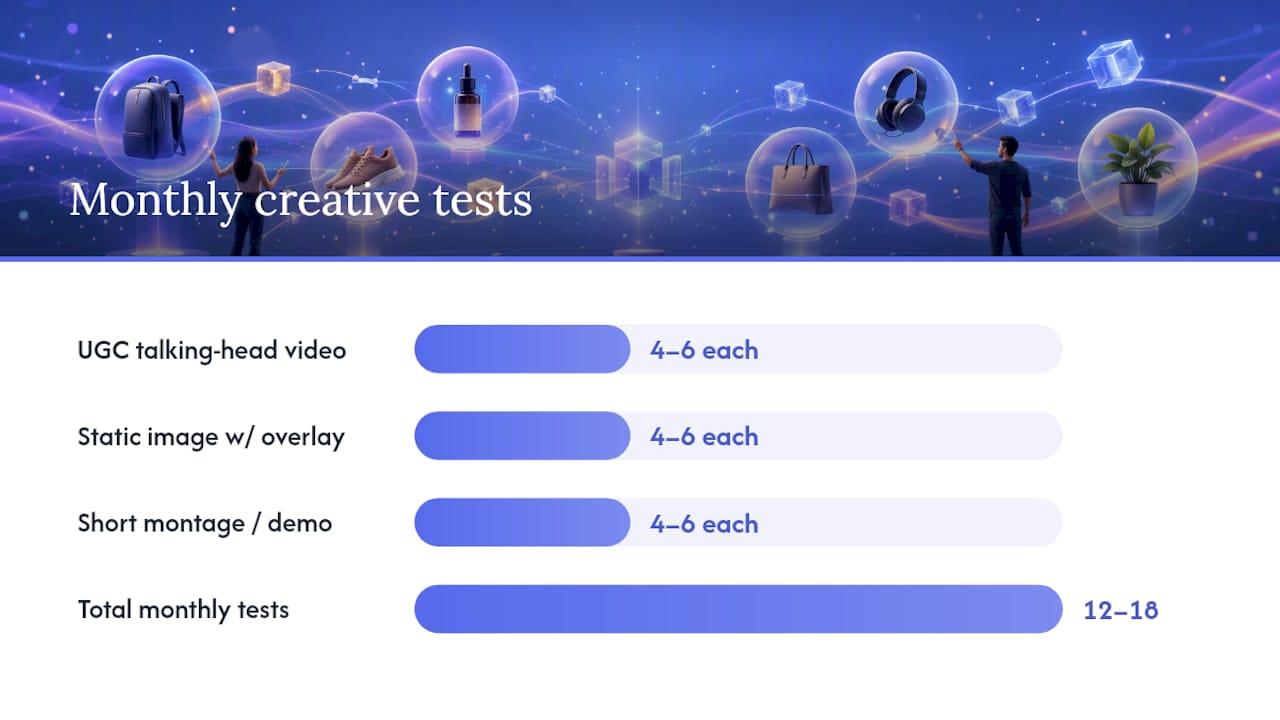
Plan on at least 8 new creatives per month for a mid-scale ecommerce account to stay ahead of fatigue under broad targeting, a cadence that holds up across most accounts I’ve audited regardless of vertical.
Signals that tell you a creative needs rotation:
- Hook rate (3-second view rate) drops more than 20% from its first-week baseline
- Frequency crosses 3 to 4 on a TOFU broad audience within a 7-day window
- Cost per landing page view climbs for three consecutive days with no targeting changes
- Comments shift from questions and tags to complaints or “seen this ad everywhere” callouts
Format matters differently by stage. TOFU wants fast, native-feeling video because you’re competing for attention in a feed people scroll past in under a second, and mobile viewing dominates Facebook traffic, so anything not built vertical-first is fighting an uphill battle before the message even lands. MOFU wants longer-form testimonial or comparison content because the viewer has already decided to pay attention, and you’re now answering a specific objection. BOFU wants dynamic product creative with a visible offer, since the viewer already knows the product and needs a reason to act today instead of tomorrow.
One pattern that surprises people running their first real funnel: the same exact ad often performs differently by stage. A testimonial video that flops as a cold TOFU ad can become your best BOFU closer, because the context the viewer brings to it changes what the content means to them.
Tracking, Attribution, and Measurement That You Can Actually Trust
Meta recommends running the Meta Pixel and Conversions API together, and treating this as optional is the single most common reason accounts report unreliable numbers. The Pixel captures browser-level signals, click IDs, and behavioral data that only exist client-side. CAPI recovers server-side events that ad blockers, iOS privacy settings, and cookie restrictions increasingly prevent the Pixel from seeing on its own. Running Pixel alone in 2026 means missing a real chunk of your actual conversions, since browser-only tracking has been degrading for years as privacy restrictions tighten.
Many implementations that switch from Pixel-only to a dual Pixel-plus-CAPI setup see a significant increase in recorded conversions, simply because the server-side signal recovers events the browser never saw.
The part that trips up most setups isn’t turning CAPI on. It’s deduplication. If the same purchase event fires from both the Pixel and CAPI without a matching identifier, Meta counts it twice, and your reported conversions inflate while your real ROAS gets buried underneath phantom volume. The fix is generating a single unique event_id at the moment the order is created and passing that exact same ID through both the client-side Pixel call and the server-side CAPI call. Get this wrong and every downstream number, ROAS, cost per acquisition, funnel attribution, becomes unreliable without you knowing it.
A short validation checklist before you trust your numbers:
- Check your Event Match Quality (EMQ) score in Events Manager; anything consistently below 6 or 7 needs more matched customer parameters (email, phone, external ID)
- Run Meta’s Test Events tool to confirm Pixel and CAPI events are firing with matching event_id values, not duplicating
- Cross-check a sample week of reported purchases against your payment processor’s actual order count
- Confirm event priority is correctly set in Aggregated Event Measurement, since only 8 events per domain get tracked under iOS restrictions, and purchase should almost always outrank lower-funnel events like add-to-cart for priority
On attribution windows, match the window to the actual sales cycle, not to whatever Meta defaults to. A 7-day click window fits impulse categories like snacks or accessories. A 28-day click window fits considered purchases like mattresses or furniture, where someone might browse for two weeks before buying. And regardless of window choice, judge the account on blended ROAS, meaning total revenue divided by total ad spend across every stage, rather than judging each campaign in isolation. TOFU campaigns almost never show strong direct ROAS because that’s not their job; they feed the MOFU and BOFU pools that do the closing. Retailers using an omnichannel view of the customer journey, where assisted conversions across touchpoints get counted, consistently see stronger measured outcomes than those judging each channel or campaign in a silo.
Budget Allocation: How Much Goes to Each Stage
The right split depends almost entirely on how mature your warm audience pools are, not on some universal percentage that applies to every account.
| Brand stage | TOFU | MOFU | BOFU | Why |
|---|---|---|---|---|
| New brand (thin pixel data, small warm pool) | 65% | 15 to 20% | 10 to 15% | You have almost no retargeting pool yet, so most spend has to go toward building one |
| Growing brand (established pixel, steady sales) | 50 to 60% | 20% | 20% | Warm pools are large enough to justify dedicated MOFU and BOFU budget without starving prospecting |
| Mature brand (large warm pools, repeat customers) | 40% | 20% | 30% | Retargeting pools can absorb more spend profitably, and repeat-purchase BOFU often carries the account |
These ranges track closely with the industry guidance I rely on when auditing new accounts, and I adjust within them based on category and repurchase frequency.
Three signals tell me an account is ready to scale rather than just spend more:
- Stable conversion counts over at least 7 to 10 days, not a single lucky day
- Creative velocity keeping pace with fatigue, meaning new creative is entering the rotation before existing winners burn out
- EMQ scores holding steady or improving, confirming the tracking foundation won’t crumble under higher volume
Meta’s delivery system treats large budget jumps as a mini relearning event, and I’ve watched accounts lose a week of stable performance chasing a scale-up that moved too fast.*
The safest scaling tactic isn’t raising budget on your best ad set in isolation. It’s duplicating the winning ad set into a fresh campaign at a similar budget, then raising spend gradually across both. That protects you from a single point of failure if the original ad set’s delivery destabilizes, and it’s a pattern I cover in more depth in how to scale Facebook ads without wrecking your ROAS.
Common Mistakes and a 6-Week Troubleshooting Checklist
Most funnel problems trace back to four repeat offenders, and running through them in order usually finds the issue faster than guessing.
- Audience overlap between stages. Use Meta’s audience overlap tool to check TOFU against MOFU and MOFU against BOFU monthly; anything above 20% overlap needs tighter exclusions.
- Frequency creeping past comfortable thresholds. Anything above 3 to 4 on a small BOFU pool, or above 2 to 3 on broad TOFU, usually signals fatigue setting in before performance data confirms it.
- Killing TOFU because it doesn’t show direct ROAS. This is the most expensive mistake in the whole funnel, since it quietly collapses the warm pools that MOFU and BOFU depend on two to three weeks later.
- Deduplication failures inflating conversion counts. Revisit your event_id setup if reported conversions don’t match your payment processor’s actual order volume, following the same audit steps I use when running a Facebook ads audit.
| Week | What to check |
|---|---|
| 1 to 2 | Learning phase status, event volume per ad set, initial CPM sanity check |
| 3 | First hook rate and frequency data on TOFU creative |
| 4 | MOFU add-to-cart cost trend, audience overlap check |
| 5 | BOFU ROAS stabilization, exclusion list refresh |
| 6 | Blended account ROAS review, decide scale or iterate |
My Practical Notes and Lessons Learned Running Funnels for Ecommerce Brands
The pitfall I’ve watched repeat across the most accounts isn’t a technical setup mistake. It’s impatience with TOFU. A founder sees a prospecting campaign with a 1.2 ROAS next to a retargeting campaign showing 6.0, and the instinct is to kill the “underperformer” and pour that budget into the “winner.” Three weeks later, the retargeting campaign’s ROAS starts sliding because there’s no fresh audience feeding it anymore. The fix isn’t complicated, it’s just uncomfortable: judge TOFU on landing page views and hook rate, not ROAS, and trust the blended number at the account level instead.
Two tactical habits I push every client toward immediately. First, generate the event_id at order creation and pass it identically to Pixel and CAPI before doing anything else with tracking, because every other number in the account depends on that one detail being right. Second, treat creative refresh as a calendar task, not a reactive one. Waiting for fatigue signals to show up before producing new creative means you’re always a week behind, and that week compounds every month you skip it.
— Stefano Mazzei
How My Team at Cosma Can Help You Build or Fix Your Funnel
Running a clean TOFU, MOFU, BOFU structure with dual-signal tracking sounds straightforward on paper, but most accounts I audit have overlap, dead exclusions, or a Pixel-CAPI mismatch nobody caught. That’s the gap between reading a framework and running one profitably at scale.

My team at Cosma works with DTC and ecommerce brands across the U.S. and Canada on exactly this: account audits that catch overlap and tracking issues before they cost you another month of ad spend, funnel strategy and rebuilds when a structure has grown messy over time, and creative testing systems that keep the angle-and-format matrix running without you having to manage it manually. If you want to see what that work actually looks like on real accounts, our case studies break down the specific changes and results behind them, and our portfolio shows the creative side of that process. If your funnel feels stuck, an audit is usually the fastest way to find out why. You can book a call with my team and we’ll tell you honestly whether a rebuild, a tracking fix, or a creative reset is the actual priority.
Sources
For the tracking setup covered above, AdsGo’s Pixel and CAPI guide goes deeper into event mapping and deduplication edge cases. For the full-funnel structure itself, AdsGo’s TOF-MOF-BOF guide expands on exclusion logic. For budget bands by brand maturity, AdPlay’s funnel budgeting guide has more granular examples. For funnel analytics and KPI tracking practices, Beacon’s guide to campaign funnel analytics is a solid practical companion.
FAQ
What Is a Facebook Ads Funnel?
A Facebook ads funnel is a set of campaigns, each built around one job in the buying journey, awareness (TOFU), consideration (MOFU), or conversion (BOFU), with distinct objectives, creative, and audiences at each stage.
What Is the 3-2-2 Method of Facebook Ads?
Definitions of the 3-2-2 method vary across sources and it isn’t a standard Meta framework, so rather than state an unverified breakdown, focus on the proven structure instead: 3 campaign stages (TOFU, MOFU, BOFU), roughly 2 to 3 creative formats tested per angle, and strict audience exclusions between each layer.
Is $1,000 Enough for Facebook Ads?
It can work for a compressed two-campaign funnel (TOFU prospecting plus a combined MOFU/BOFU retargeting campaign) on a single product line, but splitting a low budget across three fully separated campaigns usually leaves each one short of the roughly 50 weekly optimization events needed to exit the learning phase reliably.
What Is the Funnel Strategy of Ads?
The funnel strategy of ads means matching campaign objective, creative, and audience to where a prospect sits in the buying journey, cold and unaware, warm and considering, or hot and close to buying, rather than running one campaign optimized for purchases against everyone at once.


