
How to Scale Facebook Ads Without Wrecking Your ROAS
How to Scale Facebook Ads Without Wrecking Your ROAS
Scale a winning ad set by raising budget 10 to 20 percent every 72 to 96 hours, keeping a creative buffer ready, and expanding audiences only after performance holds steady for at least a week. That’s the whole strategy, mechanically speaking. The failure point is almost never the math. It’s impatience: marketers double budgets overnight, stack three changes at once, and then can’t tell which one tanked their ROAS.
Before touching a budget field, run this check: has the ad set cleared roughly 50 optimization events, is CPA stable over the trailing week, and is frequency still under 3? If yes to all three, you’re clear to scale. If not, fix that first.
- Verdict: scale validated winners with small, timed budget steps plus a creative buffer and planned audience expansion.
- Immediate action: run the readiness check (stable ROAS/CPA, ~50 events, frequency under 3) before any spend increase.
Pro Tip: Screenshot your ad set’s stats before every scale attempt. When something breaks two days later, you’ll actually know what “before” looked like.
Key Takeaways
Profitable Facebook Ads scaling depends on validating winners first, then applying small, timed budget increases alongside a creative buffer and planned audience expansion.
| Point | Details |
|---|---|
| Confirm readiness first | Check for ~50 optimization events, 7 to 14 days of stable ROAS/CPA, and frequency under 3 before scaling. |
| Use the 10 to 20% rule | Increase budget in 10 to 20% steps every 72 to 96 hours to avoid resetting the learning phase. |
| Match method to bottleneck | Scale vertically when headroom exists; go horizontal once frequency climbs or ROAS flattens. |
| Keep a creative buffer | Stage 4+ variants at mid spend and several variants at high spend to stay ahead of fatigue. |
| Work with Cosma for hands-on execution | Stefano Mazzei’s team at Cosma applies these exact readiness checks and cadence rules when managing client ad accounts. |
Table of Contents
- How Do You Know If Your Account Is Ready to Scale Facebook Ads?
- Vertical vs Horizontal Scaling: Which One Fixes Your Problem?
- What Signals Actually Mean an Ad Set Is Ready to Scale?
- What’s the Right Cadence for Facebook Ads Budget Scaling?
- How Many Ad Creatives Do You Need to Scale Safely?
- When Should You Switch From ABO to CBO or Advantage+?
- What Horizontal Moves Add Reach Without Killing Performance?
- What Should You Watch Daily, and When Do You Roll Back?
- What Does a 2 to 3 Week Scaling Playbook Actually Look Like?
- Why This Matters More Than Most Founders Realize
- What the Industry Gets Wrong About Scaling
- Want Help Scaling Without Guessing?
- Sources
- FAQ
How Do You Know If Your Account Is Ready to Scale Facebook Ads?
Run this five-point check before adjusting anything:
- ROAS/CPA stability — hold within a normal range for 7 to 14 days, not just one good day.
- Learning phase — confirm the ad set has logged close to 50 optimization events.
- Creative frequency — check current frequency against how many fresh creatives you have queued.
- Audience headroom — verify the audience isn’t already saturated or overlapping with other ad sets.
- Rollback trigger defined — decide in advance what CPA increase or frequency level forces a pause.
Pro Tip: If you can’t answer all five without opening five different tabs, build a single dashboard. Guesswork under pressure is how good ad sets get killed.
Vertical vs Horizontal Scaling: Which One Fixes Your Problem?
Vertical scaling means raising the budget on an ad set that’s already working. It’s the fastest lever when you still have audience headroom and the algorithm hasn’t started struggling to find buyers.
Horizontal scaling means adding new audiences, creatives, or placements instead of pushing more money into the same pool. It is the better move once a campaign shows saturation signs like climbing frequency or flattening ROAS despite good creative.
- Vertical works when: the audience is large, frequency is low, and ROAS has been consistent for over a week.
- Horizontal works when: frequency is climbing, CPMs are rising, or you’ve already pushed vertical budget increases twice without new headroom.
- Trade-off: vertical is faster but resets learning if you push too hard; horizontal is slower to validate but builds long-term durability by combining both methods into one sequenced system.
A $200-a-day ad set with frequency at 1.8 is a vertical candidate. A $200-a-day ad set with frequency at 3.6 needs new audiences, not more budget.
What Signals Actually Mean an Ad Set Is Ready to Scale?

Don’t scale off a lucky Tuesday. Meta and most practitioners treat roughly 50 optimization events in a seven-day window as the marker for exiting the learning phase, and scaling before that point almost always produces noisy, unreliable data.
Beyond that threshold, look for:
- ROAS or CPA holding steady across a 7 to 14 day window, not a single spike day.
- Enough conversion volume for your spend tier. Low-spend accounts (under $100/day) need patience; higher spend tiers should hit event thresholds faster.
- Frequency and CTR trending flat or improving. A rising frequency paired with a falling CTR is your early fatigue warning, well before ROAS actually drops.
A two-week stability window smooths out normal auction noise, so a single strong week isn’t proof you found a real winner.
What’s the Right Cadence for Facebook Ads Budget Scaling?
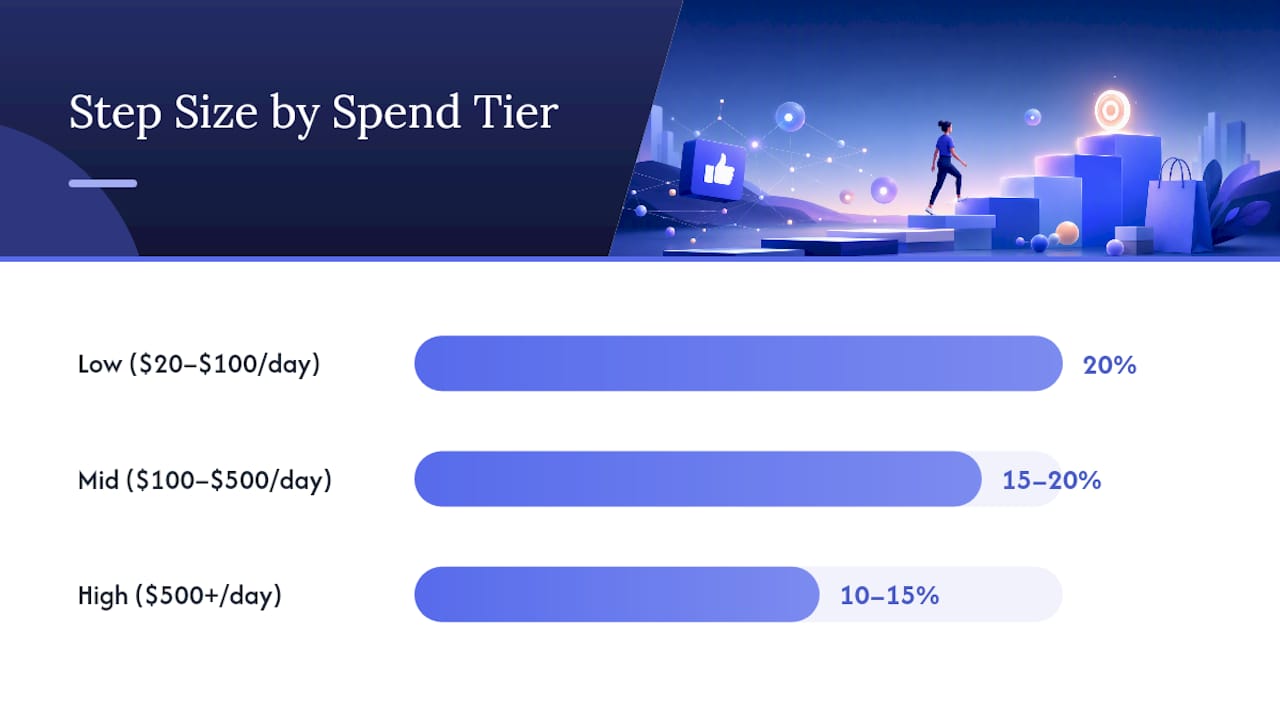
The safest, most tested rule: increase daily budget by 10 to 20 percent every 3 to 5 days, with 30 percent as an aggressive upper ceiling for a single step. Bigger jumps commonly re-trigger the learning phase, and performance dips typically last several days while the algorithm re-learns delivery.
Faster paths exist if you don’t want to wait through iterative percent increases:
- Duplicate the winner at a higher budget so it builds fresh signal without disturbing the original ad set.
- Run parallel campaigns targeting the same audience with different creative to add spend without stacking risk on one ad set.
- Shift to Advantage+ or CBO once you have multiple proven ad sets, letting Meta’s budget allocation do the heavy lifting.
| Spend Tier | Suggested Step Size | Wait Window |
|---|---|---|
| Low ($20–$100/day) | 20% increments | 4–5 days |
| Mid ($100–$500/day) | 15–20% increments | 3–4 days |
| High ($500+/day) | 10–15% increments | 3 days |
How Many Ad Creatives Do You Need to Scale Safely?
Creative supply is a scaling constraint, not an afterthought. Once frequency climbs past 3.0 to 4.5 over a seven-day span, or CTR starts sliding while CPM climbs, that’s fatigue setting in. Shopify’s guidance for ecommerce advertisers is blunt about this: creative variety isn’t optional once you’re spending real budget.
Buffer sizing that actually holds up:
- Mid spend ($100 to $500/day): keep at least 4 ready-to-launch variants staged at all times.
- High spend ($500+/day): keep several variants in rotation, split across formats.
- Retire a creative once it shows two fatigue signals at once (rising frequency plus falling CTR), not just one.
- Broad and Advantage+ audiences lean harder on creative variety since the algorithm has less targeting signal to work with, so thin creative pipelines hurt those campaigns first.
Pro Tip: Stage your next three creatives in drafts before you need them. Waiting until fatigue hits to start briefing new creative guarantees a performance gap.
When Should You Switch From ABO to CBO or Advantage+?
Use ABO (ad set budget optimization) while you’re still testing, since it guarantees each variant gets spend instead of getting starved by the algorithm. Once you have multiple proven ad sets, consolidate into CBO or Advantage+ so Meta can allocate budget dynamically across winners.
- Set ad-set minimum spend levels for the first 7 days after migrating, so the algorithm doesn’t starve a proven performer while it re-learns delivery.
- Watch CPA and frequency daily during that first week. A spike beyond your rollback threshold means reverting to ABO temporarily.
- Advantage+ Shopping campaigns tend to exit learning faster for ecommerce because conversion events aren’t fragmented across a dozen separate ad sets.
What Horizontal Moves Add Reach Without Killing Performance?
Horizontal scaling works when you expand deliberately, not all at once.
- Lookalikes: start at 1%, and once performance holds, test 3 to 5% for added reach. Seed quality (purchasers over site visitors) matters more than seed size.
- Broad or Advantage+: run as a separate experiment with its own budget rather than folding it into an existing campaign, so you can isolate its performance cleanly.
- Placements: expanding into Reels and Stories requires vertical, native-feeling creative. Repurposed feed ads usually underperform there.
- Geo expansion: test new regions with a minimum budget that can realistically hit your conversion threshold in under two weeks, not a token spend that never generates signal.
What Should You Watch Daily, and When Do You Roll Back?
Track ROAS or CPA, frequency, CTR, CPM, and conversion rate every day, but treat CTR and engagement trends as leading indicators, not just confirmation after the fact. Sprout Social’s research on engagement metrics backs this: CTR often slides before ROAS actually collapses, giving you a warning window if you’re watching closely.
Concrete rollback triggers:
- CPA rises more than 15% above your target for two consecutive days.
- Frequency crosses 3.5 to 4.0 without a corresponding CTR increase.
- CTR drops 20% or more from its baseline over a rolling three-day window.
Give any single change 72 to 96 hours before judging it. Reacting daily to normal auction fluctuation is how good ad sets get killed prematurely.
What Does a 2 to 3 Week Scaling Playbook Actually Look Like?
- Week 1, days 1 to 4: Validate. Confirm ~50 events, stable CPA, frequency under 3. No budget changes yet.
- Days 4 to 10: Vertical scale in 10 to 20% steps every 72 to 96 hours. Check performance before each new increase, and roll back immediately if your triggers hit.
- Days 10 to 17: Once vertical headroom tightens (frequency climbing, ROAS flattening), expand horizontally: new lookalike tiers, a broad/Advantage+ test, or one new placement.
- Days 17 to 21: Consolidate proven ad sets into CBO or Advantage+ with 7-day minimums set. Keep the creative pipeline running in parallel the entire time, avoiding common mistakes like stacking multiple changes at once, which is one of the fastest ways to blow up a working campaign.
Why This Matters More Than Most Founders Realize
I’m Stefano Mazzei, Co-Founder of Cosma, where my team and I run paid acquisition and creative strategy for ecommerce and DTC brands across the US and Canada. Every rule in this article, the percent steps, the event thresholds, the frequency caps, is what we actually use when we scale client accounts.
The brands that scale profitably aren’t the ones with the biggest budgets. They’re the ones disciplined enough to wait 96 hours before touching a budget field again, even when the ROAS looks great on day two.
We track campaign structure, creative fatigue curves, and audience overlap as core inputs on every account we manage, and you can see how that plays out in our portfolio and case studies. If you want a second set of eyes on your account, you can book time with my team.
What the Industry Gets Wrong About Scaling
Most scaling advice treats budget increases as the whole strategy, when budget is actually the easiest variable to control. The harder constraint is almost always creative supply. I’ve watched brands follow the 10 to 20 percent rule perfectly and still stall out, because they had two creatives running and no pipeline behind them. The percent rule protects you from the algorithm. It does nothing to protect you from creative fatigue, and that’s usually what actually kills scaling attempts.
The other overlooked piece: horizontal scaling gets treated as a fallback for when vertical scaling stops working, rather than something you plan for in advance. By the time frequency hits 4.0 and ROAS starts sliding, you’re reacting under pressure instead of executing a plan you built two weeks earlier.
If I had to prioritize one thing for a founder reading this, it wouldn’t be the budget cadence. It would be building a creative buffer before you need it. Every account I’ve seen struggle with scaling had the same root cause: they ran out of fresh creative right as the algorithm needed something new to test. The math around percent increases is the easy part. Keeping a pipeline of untested, high-quality variants ready at all times is where the real work happens.
— Stefano Mazzei
Want Help Scaling Without Guessing?
Running this playbook solo takes discipline and time most founders don’t have between product development, fulfillment, and everything else on a growing brand’s plate. If you’d rather have someone who runs these exact checks daily across multiple accounts, my team at Cosma builds and manages paid acquisition systems for ecommerce and DTC brands, primarily in the US and Canada, combining media buying with creative strategy and ongoing testing.
We work directly with founders and growth teams who want their budget scaling, creative pipeline, and audience expansion handled as one coordinated system instead of three disconnected tasks. You can see the creative approach behind our client work in the portfolio, review real account outcomes in our case studies, or dig deeper into the frameworks I use personally on Stefanomazzei. If you’re ready to talk through your account specifically, book a call with my team and we’ll walk through where your scaling bottleneck actually is.
Sources
- How to Scale Facebook Ads Without Breaking Performance: 2026 Guide (AdLibrary)
- How to Scale Facebook Ads in 2026 for Higher ROAS and Growth (Cropink)
- How to Scale Facebook Ads Without Losing ROAS (AdsGo)
- How to scale Facebook ads (Shopify blog)
FAQ
What Is the 3-2-2 Method for Facebook Ads?
It’s a creative testing framework using 3 headlines, 2 images or videos, and 2 ad copy variations to quickly identify which combination performs best before committing spend to a single creative.
Is $10 a Day Enough for Facebook Ads?
It can work for very early testing or hyper-local campaigns, but $10/day rarely generates enough conversions to reach the roughly 50 optimization events needed to exit the learning phase in a reasonable window.
What Does It Mean to Scale Facebook Ads?
Scaling means increasing ad spend or reach on campaigns that already show stable, profitable performance, using controlled budget increases (vertical scaling) or new audiences and creative (horizontal scaling) rather than random, unplanned spend hikes.
How Much Do 1,000 Clicks Cost on Facebook?
Cost per click varies widely by industry, audience, and creative quality, so there’s no fixed number. Tracking your own CPC trend alongside CTR and CPM matters more than comparing against a generic benchmark.
Should I Duplicate a Winning Ad Set Instead of Increasing Its Budget?
Duplicating a winner at a higher budget can add spend faster than incremental percent increases, since the copy builds its own learning signal without disrupting the original ad set’s performance.