Creative First Facebook Ad Testing for DTC: The 50 Event Rule
The fastest way to get repeatable wins from Facebook ad testing is simple to state and hard to execute: test one variable at a time, pick a single primary metric and a sample size before you launch, isolate your audiences so tests don’t overlap, let each variant reach a minimum threshold of optimization events sufficient for reliable results, and pair Meta Pixel with Conversions API so your data holds up. I’ve run this exact sequence with brands at Cosma for years, and the accounts that skip a step are always the ones asking why their “winning” ad stopped winning.
TL;DR:
- Proper Facebook ad testing requires a clear hypothesis, a single primary metric, and sufficient sample size to avoid misleading results.
- Using campaign budget optimization for testing undermines control, as the algorithm favors best performers, which can skew test validity.
- Confirm tracking and data accuracy with Meta Pixel and Conversions API before launching tests, and focus on larger effect sizes of 20% or more for reliable measurement.
- Creative variations like hooks should be tested within a week, while brand messaging and narratives require two weeks or longer to produce conclusive results.
- Continuous discipline and scheduled testing cycles outperform sporadic efforts, with a recommended budget of at least $30 per day to reach the 50-conversion minimum needed for trustworthy insights.
Table of Contents
- What Is Facebook Ad Testing and Why Most Teams Get It Wrong
- How Do You Structure a Facebook Ad Test Step by Step?
- Creative Testing Priorities: What to Test First and How Long It Takes
- ABO vs CBO: Which Campaign Structure Gets You a Clean Test?
- Fixing Your Measurement Setup Before You Trust Any Test Result
- Scaling a Winner Without Triggering Creative Fatigue
- The Statistics Behind a Trustworthy Test Result
- Your Testing Checklist and Post-Test Report Template
- Practitioner Notes: Common Mistakes I See in Facebook Ad Testing
- Why Creative Testing Is Ecommerce’s Best Growth Investment
- How My Team at Cosma Can Help You Test Smarter
- Sources
- FAQ
What Is Facebook Ad Testing and Why Most Teams Get It Wrong
Facebook ad testing, sometimes called split testing Facebook ads or A/B testing Facebook ads, is the practice of isolating one variable in a campaign (a hook, an offer, an audience, a bidding strategy) and measuring its effect on a single metric against a control. Most teams call this “testing” when what they’re actually doing is running two ads and eyeballing which one feels better after two days. That’s not testing. It’s guessing with extra steps.
The distinction matters because Meta’s algorithm in 2026 rewards signal quality more than raw spend. A test that isn’t statistically sound doesn’t just waste budget. It teaches you the wrong lesson, and then you scale that wrong lesson into your best-performing campaign. Meta’s own A/B testing guidance exists specifically because advertisers kept drawing conclusions from overlapping audiences and contaminated data.
Real Facebook ad testing requires three things working together: a valid hypothesis, a clean statistical setup, and the patience to let the test finish before you touch it. Everything below builds on those three pillars.
Define one hypothesis and one primary metric
Before you touch Ads Manager, write down what you’re testing and why. “I think a UGC-style hook will outperform our polished studio hook because it looks native to the feed” is a hypothesis. “Let’s see what happens” is not.
Pick one primary metric tied to that hypothesis, whether that’s cost per acquisition, return on ad spend, or conversion rate, and ignore the rest of the dashboard until the test concludes. Mixing metrics midway through a test is how marketers convince themselves a loser is actually a winner.
Respect sample size before you trust the result
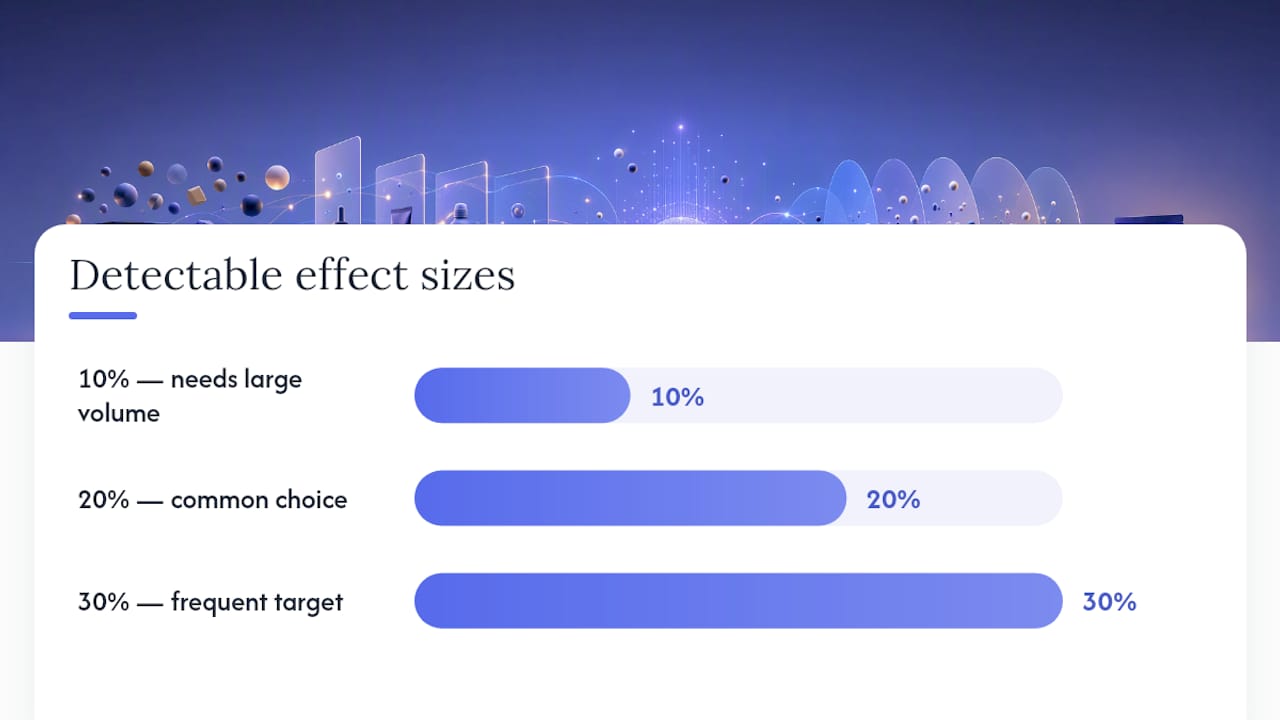
Most ecommerce accounts don’t have that kind of volume, which is why statistical guidance from Wevion recommends testing for larger, more detectable effects of 20% to 30% and treating a practical minimum number of optimization events per variant as a baseline for reliable results.
- Write the hypothesis and primary metric before launch, not after.
- Calculate rough sample size needed based on your expected effect size.
- Never peek at results and make decisions before the test hits its event threshold.
- Log every test in a shared doc: dates, budget, audience, creative, and outcome.
Peeking early is the single most common way testing budget gets wasted. Checking results daily and killing a “losing” ad on day two inflates your false positive rate because early data is noisy by nature.
Pro Tip: Set a calendar reminder for your test’s end date and don’t open Ads Manager’s breakdown view until then. If you can’t resist checking, have someone else own the “do not touch” period.
How Do You Structure a Facebook Ad Test Step by Step?
Running a clean test isn’t complicated, but it does need to happen in order. Skipping steps is what turns a two-week test into a two-month argument about whether it even worked.
- Confirm tracking first. Check that Meta Pixel is firing and Conversions API events are matching in Events Manager before you spend a dollar. A test built on broken tracking is worthless no matter how well you designed it.
- Establish your baseline. Pull your current CPA or ROAS from the last two to three weeks of stable spend. This is what your test variant needs to beat, not some target from a forecast deck.
- Choose your isolation method. For a controlled creative or audience test, use Meta’s Experiments tool to split audiences at the back end and prevent overlap. For simpler tests, manual audience exclusions work, but Experiments does the cleaner job automatically.
- Calculate your budget. Divide your target conversion count (that 50-event minimum) by your expected conversion rate, then multiply by your expected CPA. If you expect a 3% conversion rate and a $40 CPA, you need roughly 1,700 clicks to hit 50 conversions, which tells you your minimum weekly spend before you even launch.
- Monitor delivery, not performance. During the run, watch for delivery issues, audience overlap warnings, and spend pacing. Do not touch bids, budgets, or creative mid-test.
- Apply your decision rule. At the end of the run, you have three outcomes: a statistically valid winner, an inconclusive result (rerun with a longer window or bigger budget), or a clear loser you retire and replace.
Most failed tests fail at step 4. Teams launch with a budget sized for their comfort level instead of the math their conversion rate demands, then wonder why three weeks produced 22 conversions and no clear answer.
Creative Testing Priorities: What to Test First and How Long It Takes
Creative is the highest-leverage variable in Meta’s 2026 delivery environment, ahead of audience targeting or bid strategy, largely because the algorithm has gotten so good at finding people that the ad itself now decides whether they stop scrolling. That’s the order I use with every account at Cosma, and it maps to how fast each element produces a reliable signal.
Test in this order: hook, format, offer, narrative, and CTA last. The hook is the first two to three seconds of a video or the first line of a static ad’s copy, and it determines whether anyone sees the rest of your message. Meta’s own small-business guidance points advertisers toward starting with copy and visuals before touching audience settings, which lines up with what actually moves performance fastest.
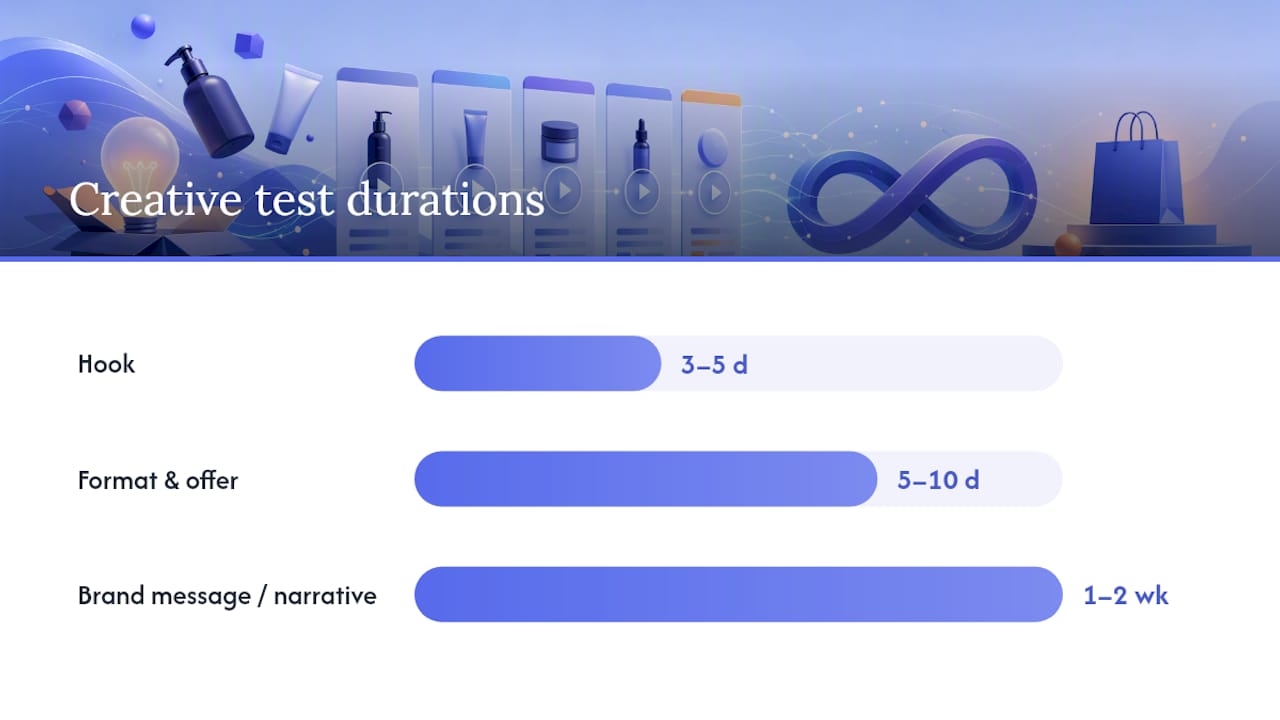
- Hook tests: 3 to 5 days. Watch thumb-stop rate and early click-through rate. These signals arrive fast because they’re driven by impressions, not conversions.
- Format and offer tests: 5 to 10 days. A carousel versus a single video, or a bundle discount versus a percentage off, needs more time because it touches mid-funnel behavior.
- Brand message and narrative tests: 1 to 2 weeks or longer. These affect how someone feels about your brand, which shows up slower and needs a full purchase cycle to read cleanly.
Run concept-level tests first, three or four genuinely different creative directions, before isolating individual elements within the winning concept. Testing five hook variations of a concept that never resonated is a fast way to burn budget on the wrong hypothesis. My performance creative framework walks through how I stage this from concept to isolated variable inside a single testing calendar.
Pro Tip: Instrument hook performance with the “3-second video plays” and “thumb-stop ratio” metrics inside Ads Manager’s breakdown view, not just CTR. CTR conflates hook strength with offer strength, and you want to know which one is actually broken.
ABO vs CBO: Which Campaign Structure Gets You a Clean Test?
Use ad-set budget optimization (ABO) when you’re running a controlled test and need every variant to get a guaranteed, equal amount of spend. Use campaign budget optimization or Advantage+ campaign budget when you’re past testing and scaling a confirmed winner, because Meta’s automation needs freedom to shift budget toward whatever’s converting best.
The mistake I see constantly is running a test inside a CBO or Advantage+ campaign. The algorithm will starve your “control” variant of spend within 48 hours because it looks like the weaker performer early on, before either variant has a fair shot at proving itself. Meta’s Advantage+ guidance frames this correctly: Advantage+ is built for scale, not for controlled comparison, and it works best with strong existing signal already in place.
Meta’s stated benchmark for exiting the learning phase is a certain threshold of optimization events per ad set within a week. That number isn’t arbitrary. It’s the rough point where the algorithm has enough data to stop exploring and start optimizing. Below that, your delivery is volatile and your CPA numbers are unreliable.
- Calculate weekly spend needed by dividing 50 by your expected conversion rate, then multiplying by your average order value’s implied CPA.
- If your target CPA is $35 and you need the minimum recommended conversions in a week, budget accordingly per variant during the test window.
- Avoid the “edit loop”: every significant edit to an ad set resets its learning phase, so resist the urge to tweak mid-test.
- Consolidate similar audiences into fewer, larger ad sets. Fragmented budgets across ten small ad sets each starve individually and none of them exit learning cleanly.
A proper account audit usually turns up three or four ad sets quietly cannibalizing each other’s budget before a single test even launches.
Fixing Your Measurement Setup Before You Trust Any Test Result
No testing framework survives broken tracking. Before you launch anything, confirm Meta Pixel and Conversions API are both firing and reporting matching event counts in Events Manager.
Running Pixel alone leaves you exposed to browser-level tracking restrictions that undercount real conversions, especially on iOS. Layering Conversions API on top sends the same events from your server, which Shopify’s advertiser guidance recommends specifically because it closes the gap browser tracking leaves open and gives Meta’s algorithm a cleaner signal to optimize against.
For attribution windows, a 1-day click window tends to produce cleaner reads for creative tests because it isolates the immediate impact of what someone just saw, rather than crediting a sale that happened a week later to three different ads that touched the customer along the way. Save your 7-day click window for full-funnel performance reporting, not for isolating a single creative variable.
- Reconcile Meta’s reported purchases against your actual order data weekly, not monthly.
- Watch for duplicated events between Pixel and CAPI, which inflate your reported conversions if deduplication isn’t configured correctly.
- Check that value and currency parameters match across both sources.
- Confirm your Pixel’s standard events (Purchase, AddToCart, InitiateCheckout) fire in the right sequence during a test transaction.
Detecting a 10% difference in conversion rate reliably requires a large volume of conversions, which is why most practitioners test for bigger, 20% to 30% effects instead of chasing small optimizations most accounts don’t have the traffic to measure honestly.
Scaling a Winner Without Triggering Creative Fatigue
A statistically valid winner earns a scale-up, not an overnight budget explosion.
Duplicating a winning ad set into a new campaign works better than editing the original once you’re past the initial validation, because it lets you test scaled delivery without disturbing the ad set that proved the concept.
Fatigue shows up in a predictable sequence, and catching it early saves you from riding a decaying ad past the point of no return:
- Frequency climbing past 3 to 4 within a single audience segment, especially on a narrower prospecting audience.
- Click-through rate declining over consecutive weeks while frequency rises, a strong sign the same people are seeing the same ad too often.
- Cost per result increasing without a corresponding change in audience or bid strategy.
- Landing page conversion rate dropping even though ad-level CTR holds steady, which usually points to audience fatigue rather than a landing page problem.
Keep three to five active creative variants per audience so you’re never one fatigued ad away from a performance cliff, and build your rotation calendar around whichever hook has the shortest shelf life. Practitioner resources on creative fatigue and hook rotation are worth a look if you want a deeper breakdown of how quickly hooks decay across different verticals. Re-test a proven winner every quarter, since audience saturation and seasonal shifts can revive or kill a concept that performed well six months ago.
The Statistics Behind a Trustworthy Test Result
Use a chi-square test when you’re comparing conversion rates between two variants, since you’re comparing proportions. Use a t-test when you’re comparing a continuous metric like average order value or CPA across variants.
Confidence intervals matter more than the headline number.
- Predefine your significance threshold (typically 90% or 95% confidence) before you look at any results.
- Watch for the multiple comparisons problem: testing five variants at once and picking whichever one crossed significance first is a fast route to a false positive.
- Consider sequential testing instead of one large multi-armed test, running your top two concepts against each other after an initial round narrows the field.
- Remember that statistical significance without practical significance is meaningless. A confirmed 2% CPA improvement rarely justifies the operational cost of switching creative.
Chasing marginal wins burns more creative production time than it’s worth.*
Your Testing Checklist and Post-Test Report Template
Before launch, confirm tracking is firing correctly, your baseline CPA is documented, and your audience split has zero overlap. During the run, check delivery pacing daily but leave bids and creative untouched. After the test closes, fill out a short report so the next person on your team doesn’t have to reconstruct what happened from memory.
- Record start and end dates, plus total spend per variant.
- Log conversions per variant against your primary metric.
- Note statistical significance level and confidence interval.
- State the effect size and whether it’s practically meaningful.
- Write the decision: scale, kill, or rerun.
- Name the next test this result points toward.
| Report Field | What to Record |
|---|---|
| Test dates | Start and end date, total days run |
| Primary metric | CPA, ROAS, or conversion rate |
| Conversions per variant | Raw count for each variant |
| Confidence level | 90% or 95%, as predefined |
| Effect size | Percentage difference, with CI range |
| Decision | Scale, kill, or rerun |
| Next test | The hypothesis this result suggests testing next |
Practitioner Notes: Common Mistakes I See in Facebook Ad Testing
The single most common error I see across DTC accounts is testing five variables inside one ad set and then trying to figure out which one moved the needle. You can’t. Isolate one variable, always.
The second most common mistake is underfunding tests. A brand with a $50 CPA runs a test at $30 a day and wonders why nothing hits significance after two weeks. The math never supported that timeline in the first place.
The accounts that scale fastest aren’t the ones with the biggest budgets. They’re the ones that run disciplined, one-variable tests every week without fail, then act on the result instead of arguing with it. I watch first-week thumb-stop rate and early CTR on every new creative test at Cosma, because those two numbers tell me by day three whether a concept is worth funding through a full week.
Fragmented account structure compounds both problems: ten ad sets each running their own micro-test at $15 a day never individually reach the volume needed to say anything with confidence.
Why Creative Testing Is Ecommerce’s Best Growth Investment
Creative is the highest-leverage variable you control in Meta’s 2026 delivery environment, more than bid strategy, more than audience stacking, because the algorithm has gotten remarkably efficient at finding the right person. What it can’t do is make your ad worth stopping for.
I recommend a fixed cadence over any one-off testing sprint: a weekly session to review live test data and make scale-or-kill decisions, a monthly slot for new concept-level tests, and a quarterly audit of your full creative library to catch fatigue before it shows up in your CPA. Brands that treat testing as a calendar habit outperform brands that treat it as a fire drill.
The strategy behind consistent Meta performance isn’t a secret framework. It’s discipline applied weekly, for months, without skipping the boring parts.
— Stefano Mazzei
How My Team at Cosma Can Help You Test Smarter
Running a disciplined testing cadence takes real operational bandwidth: someone has to brief creative, set up Experiments correctly, track significance, and make the scale-or-kill call every single week without fail. My team at Cosma builds that entire system for DTC and ecommerce brands across the U.S. and Canada, from campaign structure and Conversions API setup to a running creative testing calendar tied to your actual revenue numbers.

We’ve built this exact process across dozens of accounts, and you can see the kind of results it produces in our case studies. If you’re spending real budget on Meta and want a second set of eyes on how your tests are structured, book a call with my team and we’ll walk through what’s actually holding your testing back.
Sources
- Optimize your ad campaigns with A/B Testing — Meta Business
- A/B testing Facebook ads: Statistical guide — Wevion
- Optimize Facebook Ads — Shopify blog
FAQ
Is $10 a Day Enough Budget for Facebook Ad Testing?
Rarely, for a real test. At $10 a day, most ecommerce accounts take weeks or months to hit the 50 conversions per variant needed for a reliable read, which defeats the purpose of testing on a useful timeline.
Is A/B Testing Worth It on Facebook?
Yes, when it’s run correctly with a predefined hypothesis, one primary metric, and enough budget to reach statistical significance within a reasonable window. Poorly structured tests, run without isolation or sample-size planning, waste more budget than they save.
How Much Do Facebook Ads Cost per 1,000 Impressions?
CPM varies widely by industry, season, and audience, and no single figure applies across accounts, so track your own account’s CPM trend rather than benchmarking against a generic number.
Are Facebook Ads Worth It in 2026?
Facebook ads remain effective for ecommerce brands that treat creative testing as an ongoing discipline rather than a one-time setup, since Meta’s 2026 algorithm rewards strong creative signal paired with clean Pixel and Conversions API data. Brands that skip structured testing tend to see rising CPAs as their creative fatigues without a reliable follow-up plan.
Should I Use Meta’s Experiments Tool or Manual Exclusions for Testing?
Use Meta’s built-in Experiments tool when you need a guaranteed, non-overlapping audience split for a controlled test, since it handles isolation automatically. Manual exclusions work for simpler tests but carry more risk of accidental overlap.


