
The Meta Ads Strategy That Actually Works in 2026
The Meta Ads Strategy That Actually Works in 2026
The best Meta ads strategy in 2026 is a creative-first, Advantage+ led architecture backed by clean first-party data and measured against blended economics instead of platform ROAS. That’s the whole thesis. Everything else in this guide is implementation detail.
Three pillars hold this up. First, creative diversity now functions as your primary targeting lever. Second, your signal quality (mostly Conversions API hygiene) determines whether Meta’s algorithm can actually find your buyers. Third, post-click economics and retention flows decide whether the traffic you buy ever becomes a profitable customer.
If you’re managing an account right now, here’s what to do this week:
- Consolidate your ad sets into an Advantage+ Shopping Campaign (ASC) plus one lean manual testing campaign
- Launch a two-week creative sprint with at least 4 to 6 new concepts across static, video, and UGC formats
- Check your Conversions API event match quality and fix any gaps before you touch bids or budgets
I run this exact framework with my team at Cosma, and it’s the structure behind nearly every account we’ve scaled past six figures in monthly spend. The rest of this guide breaks down why it works and how to run it properly.
Key Takeaways
A creative-first, Advantage+ led Meta ads strategy built on clean CAPI signal and MER-based decision making consistently outperforms manual, targeting-heavy setups in 2026.
| Point | Details |
|---|---|
| Consolidate account structure | Move toward ASC as purchase volume grows, keeping one lean manual campaign for testing. |
| Fund the learning phase properly | Budget for roughly 50 optimized events per ad set before judging performance. |
| Treat creative as a pipeline | Launch new concepts weekly in batches of three, with fixed kill and scale thresholds. |
| Measure against MER, not platform ROAS | Calculate blended marketing efficiency ratio weekly to guide real scaling decisions. |
| Fix retention to fund acquisition | Post-purchase and win-back flows through tools like Klaviyo raise MER, which unlocks more aggressive Meta spend. |
| Work with a specialist when stuck | My team at Cosma builds this exact architecture, creative cadence, and measurement system for e-commerce brands ready to scale past a plateau. |
Table of Contents
- Meta Ads Strategy: Structuring Accounts by Spend Stage
- Building a Creative Bank: Formats, Hooks, and Testing Volume
- How Do You Test and Scale Creative Without Breaking Delivery?
- Getting Measurement Right: CAPI, EMQ, and MER
- Bidding Strategy and Learning-Phase Budget Rules
- What Breaks First When You Scale Meta Ad Spend
- The Backend Flows That Make Your Front-End Numbers Real
- A Fast Audit Checklist for Your Current Meta Account
- How My Team at Cosma Runs Meta Strategy in Practice
- Cross-Channel Integration: Meta Doesn’t Work Alone
- Staying Compliant: Meta’s Policy Rules You Can’t Ignore
- What Successful Meta Strategy Looks Like in Practice
- A Practitioner’s Honest Take on What Actually Moves the Needle
- How Cosma Helps You Run This Playbook
- Sources
- FAQ
Meta Ads Strategy: Structuring Accounts by Spend Stage
Most accounts are structured for a business that no longer exists. They’ve got 12 ad sets, six audiences, and a targeting setup built for 2019. Meta’s delivery system doesn’t reward that anymore. It rewards consolidation and clean data, and the account structure you need depends almost entirely on how much purchase signal you’re generating.
Here’s how I break down the stages:
- First sale stage (under 10 purchases a week): Run one lean prospecting campaign with broad targeting, one to two ad sets max, and a full manual bid strategy. You don’t have enough signal for ASC to work well yet, so keep the structure simple and let the algorithm find its footing.
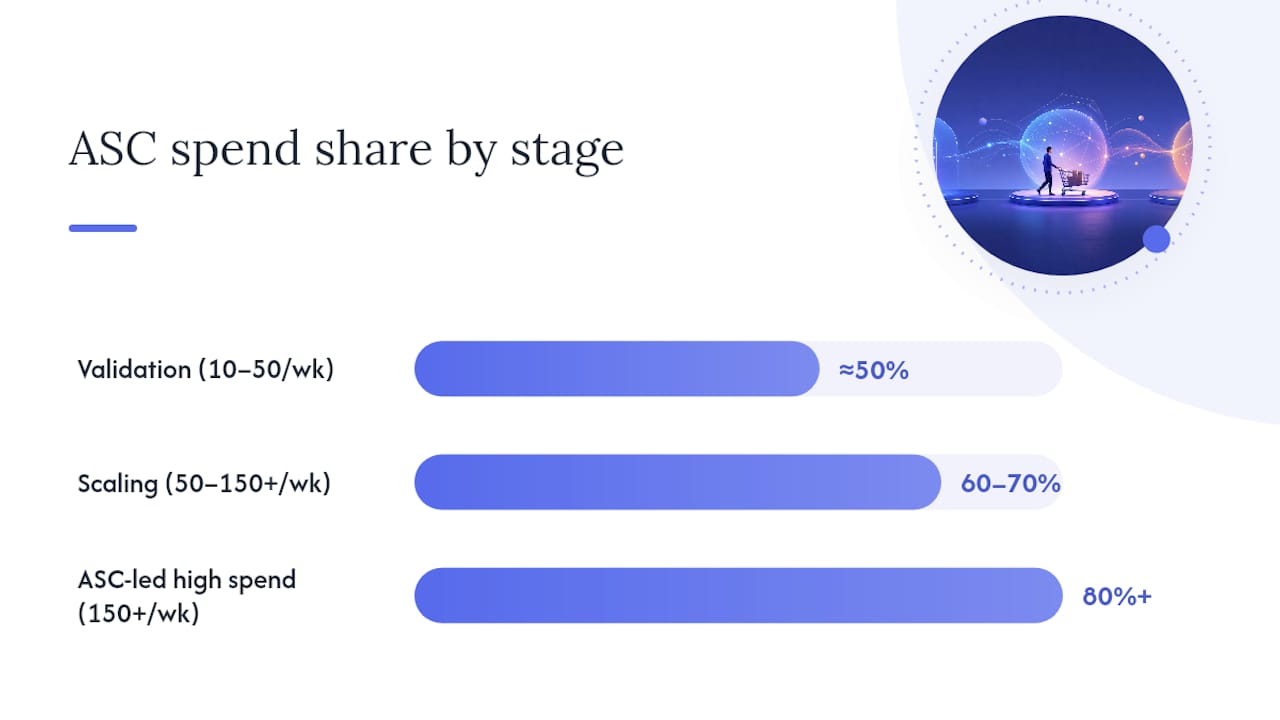
- Validation stage (10 to 50 purchases a week): Introduce an ASC alongside your manual campaign, splitting budget roughly 50/50. This is where you start feeding both engines enough data to compare performance honestly.
- Scaling stage (50 to 150+ purchases a week): Shift the majority of spend, often 60 to 70%, into ASC. Keep a smaller manual campaign purely for testing new creative concepts and audience angles before they graduate into ASC.
- ASC-led high spend (150+ purchases a week): ASC becomes your dominant engine, sometimes handling 80% or more of spend. Manual campaigns shrink to a dedicated testing sandbox with a fixed, modest budget.
That last stage lines up with what industry playbooks describe for scaled accounts, where ASC handles the majority of spend at scale, manual prospecting accounts for a smaller portion, and retargeting plus retention share the remaining budget.
Consolidation isn’t a nice-to-have. Meta’s own delivery guidance states that each ad set needs roughly 50 optimized conversion events to exit the learning phase and stabilize. Fragment your budget across eight ad sets and you’re forcing all eight to independently hit that threshold, which usually means none of them do. Consolidating into fewer, better-funded ad sets gets you out of the learning phase faster and keeps delivery stable.
The mistake I see most often: brands run a testing pipeline that’s structurally identical to their scaling campaign, just with smaller budgets. That doesn’t isolate anything. Keep your test campaign genuinely separate, with its own budget ceiling, so a bad angle can’t tank your main engine’s signal.
Pro Tip: Don’t kill your manual campaign the moment ASC starts performing. It’s your only channel for testing new creative before ASC ever sees it, and losing that pipeline is how accounts stall out at a plateau.
Building a Creative Bank: Formats, Hooks, and Testing Volume
Creative is targeting now. That’s not a slogan, it’s how the delivery system actually behaves. When Meta’s algorithm evaluates ad quality, creative diversity has become one of the strongest signals determining who sees your ad, arguably more influential than the targeting parameters you set manually.

That shift changes what “good creative operations” means. You’re not producing a handful of polished ads anymore. You’re producing a bank.
Here’s the minimum viable creative mix I recommend for any active campaign:
- At least 3 static image concepts, each testing a distinct value proposition or angle
- At least 3 short-form video concepts (15 to 30 seconds), mixing product demos and lifestyle framing
- At least 2 UGC-style pieces, ideally from real customers or creators who look like your customers
- One long-form video (60 seconds plus) for audiences further down the funnel
That’s roughly 8 to 10 live assets per active ad set at minimum, refreshed continuously rather than launched once and left alone.
Mobile matters more than most media buyers account for in their creative briefs. Mobile devices generate the overwhelming majority of Facebook ad revenue, which means every asset needs to work as a vertical, sound-off-first, thumb-stopping piece before it works as anything else. A beautiful desktop-formatted ad that gets scrolled past in 0.8 seconds on a phone is a wasted production budget.
How to instrument hook testing:
Track three metrics on every new creative, in this order of priority:
- Thumb-stop rate: the percentage of people who stop scrolling within the first second. Below 15 to 20%, your hook isn’t working, full stop.
- 2-second video view rate: whether your opening frame or line earns attention past the initial scroll-stop.
- 25% video play rate: whether the content itself holds interest once you’ve earned the stop. A big gap between thumb-stop and 25% play usually means the hook overpromised and the body underdelivered.
On refresh cadence: plan to rotate creative every 7 to 14 days for active testing concepts, and retire even winning ads once frequency climbs past 3 to 4 impressions per person in your core audience. Fatigue shows up as rising CPMs and falling click-through rate before it shows up in your ROAS, so watch the leading indicators, not the lagging one.
How Do You Test and Scale Creative Without Breaking Delivery?
You need a workflow, not a vibe. Testing creative by gut feel is how accounts burn budget on concepts that were never going to work and miss winners that needed three more days of data.
Here’s the process I run with every account at Cosma:
- Set up a dedicated test campaign with its own budget, separate from your ASC or scaling campaign, funded at roughly 10 to 15% of total spend.
- Launch in batches of 3. Test three new creative concepts at a time rather than one, so you’re comparing relative performance instead of judging a single ad in isolation.
- Set a spend threshold before judging. Don’t kill anything before it’s spent at least 2 to 3 times your target cost per acquisition, and don’t declare a winner before you’ve got enough purchases to trust the number, generally in the range Meta’s own learning-phase guidance points to.
- Apply kill/scale rules mechanically. Kill anything with a thumb-stop rate under 15% or a cost-per-purchase more than 1.5 times your account average once it’s had a fair spend window. Scale anything that beats your target CPA with at least a handful of conversions behind it.
- Migrate winners into ASC, don’t just leave them in the test campcampaign. ASC needs fresh, proven creative constantly, and your test campaign is the pipeline that feeds it.
A rotation framework helps keep this disciplined. I use a 3-3-3 approach: 3 new concepts, tested for up to 3 days before an early read, with a final call by day 3 to 5 depending on spend velocity. Some teams prefer 3-2-2, which just compresses the timeline for lower-price, higher-velocity products. Either works. What matters is that you commit to a fixed cadence instead of testing indefinitely.
Getting Measurement Right: CAPI, EMQ, and MER
Your account can look great in Ads Manager and still be quietly losing money. That gap is why measurement discipline matters more than almost anything else on this list.
Start with Conversions API. If you’re not running CAPI alongside the Meta Pixel, you’re handing the algorithm a partial picture of who’s converting, and it will optimize toward the wrong people. Meta’s 2026 platform updates have made first-party data even more central to delivery quality than in prior years, which means customer lists and server-side events now materially outperform relying on pixel-only tracking.
Once CAPI is live, check your Event Match Quality (EMQ) score inside Events Manager. Aim for a “good” or “great” rating, generally meaning most of your purchase events are matching to a real Meta identity. A poor EMQ score means the algorithm can’t reliably connect a purchase back to the ad that drove it, which quietly degrades every optimization decision downstream.
Here’s the part most brands get wrong: Meta-reported ROAS is not the number to scale against. It’s frequently inflated by attribution windows that credit Meta for purchases influenced by email, search, or organic. Industry analysis consistently recommends MER, or marketing efficiency ratio, as the more honest north star. MER is simply total revenue divided by total ad spend across all channels, and it doesn’t care which platform claims the credit.
- Calculate MER weekly, not daily, since daily blended numbers are too noisy from order timing and refunds
- Set a minimum acceptable MER before you scale spend, based on your margin structure and target contribution profit
- Treat any scaling decision based purely on in-platform ROAS as provisional until MER confirms it
For accounts spending meaningfully across channels, a multi-touch attribution tool like Northbeam or Triple Whale helps reconcile what Meta claims against what actually happened. These platforms pull in server-side and post-purchase survey data to build a more complete attribution picture, which is especially useful once you’re running Meta alongside TikTok, Google, and email simultaneously.
Pro Tip: Run an incrementality test (a simple geo holdout or PSA lift study) once a quarter if your spend supports it. It’s the only way to know for certain whether your Meta spend is generating new revenue or just claiming credit for sales that would have happened anyway.
Bidding Strategy and Learning-Phase Budget Rules
The single most common mistake I see in bid strategy is jumping to Cost Cap or target ROAS before the account has earned the right to use them. Both strategies need historical conversion data to calibrate against, and forcing them too early just starves delivery.
Here’s the sequence that actually works:
- Start with Highest Volume (formerly Lowest Cost) for any new campaign or ad set. Recent platform guidance backs this as the default entry point, since it lets Meta explore the auction freely while you’re still building signal.
- Fund the learning phase properly. Meta’s system needs roughly 50 optimized events per ad set to exit learning, per its own delivery documentation. Set your daily budget high enough to hit that within about a week, not a month.
- Layer in Cost Cap or tROAS only after volume exists, typically once you’ve got a consistent conversion history and know your target CPA within a reasonable range. Introducing either too early usually just throttles delivery without improving efficiency.
- Scale budgets in 20% increments every 3 days, not by doubling. Meta treats a large budget jump as a fresh learning-phase trigger, which resets the stability you just built.
- Low-signal accounts should stay on Highest Volume longer. High-signal accounts with hundreds of weekly conversions can move to tROAS faster and trust it sooner.
Budget floors should scale with your product’s price point. A lower-AOV product needs more daily events to hit the 50-conversion threshold, so it typically needs a higher relative budget than a premium product converting at a lower volume but higher value.
What Breaks First When You Scale Meta Ad Spend
Scaling spend doesn’t break your account. It breaks whatever was already fragile, just faster. Creative supply is usually the first casualty, followed by landing page performance, and both show up in your metrics before you’d expect.
Watch these signals as spend climbs:
- Creative supply targets: at higher spend tiers, plan for multiple new assets monthly, more than a handful. Scale burns through creative faster because frequency climbs faster.
- Frequency thresholds: once your core audience hits 3 to 4 impressions per person weekly, expect rising CPMs and softening click-through, even if ROAS hasn’t dropped yet.
- Landing page load speed and mobile checkout friction: a page that converts fine at $200 a day in spend can choke at $2,000 a day if server response times slip under higher traffic volume.
- Blended CAC trending upward while MER holds steady usually means Meta costs are rising but other channels are compensating. Worth investigating before it becomes a real problem.
- Hook rate decay across your top 3 creatives is the earliest warning sign of fatigue, well before cost-per-purchase moves.
A simple CRO check before any scaling push: test your checkout flow on a mid-range Android phone with throttled connection speed. If it’s clunky there, it’s costing you conversions you’re currently blaming on “audience saturation.”
The Backend Flows That Make Your Front-End Numbers Real
Acquisition spend only becomes profit once the customer actually converts, and then converts again. This is where a lot of otherwise sound Meta strategy quietly falls apart, because the backend gets treated as an afterthought.
- Post-purchase email sequence: send three emails minimum. One immediately (order confirmation plus a light cross-sell), one at day 3 to 5 (usage tips or unboxing content that builds trust), and one at day 10 to 14 (a review request paired with a modest incentive for the next purchase).
- Browse and cart abandonment flows: trigger email within an hour of abandonment, followed by SMS within 2 to 4 hours if you have opt-in. A second email at 24 hours with a bit more urgency closes out most of the recoverable revenue in this window.
- Win-back and replenishment segments: for consumable products, time replenishment flows to your product’s actual usage cycle rather than a generic 30-day default. Win-back campaigns targeting lapsed customers at 60 to 90 days of inactivity tend to run at strong ROAS relative to cold acquisition, since you’re re-engaging people who already converted once.
Tools like Klaviyo are the standard for building these flows because they connect directly to your e-commerce platform’s customer and order data, letting you segment by purchase history rather than blasting generic campaigns.
Here’s the strategic point that matters most: as retention improves and your backend flows mature, you can afford to be more aggressive with front-end acquisition spend, because a higher share of new customers convert into repeat buyers. Retention isn’t separate from your Meta ads strategy. It’s what makes an aggressive Meta ads strategy sustainable.
A Fast Audit Checklist for Your Current Meta Account
Block 30 to 90 minutes and run through this before you touch a single bid or budget.
- CAPI and Event Match Quality: open Events Manager and confirm your EMQ score is rated good or better. If it’s not, fix this before anything else, since every other decision downstream depends on clean signal.
- Ad set fragmentation: count your active ad sets and check conversion volume per ad set against the 50-event threshold from Meta’s own delivery guidance. Consolidate anything starved of data.
- Creative bank health: pull a report of your last 30 days of creative. If most active ads are older than 21 days with no new concepts launched, your testing pipeline has stalled.
- CRO sanity check: load your product and checkout pages on mobile with a throttled connection. Note load time and friction points.
- Attribution reality check: compare your Meta-reported ROAS to your calculated MER for the same period. A wide, growing gap between them is worth investigating before you scale spend further.
Run this quarterly at minimum. Accounts drift, and small structural issues compound fast once spend climbs.
How My Team at Cosma Runs Meta Strategy in Practice
Most of what breaks a Meta ads strategy isn’t a bad tactic, it’s a missing system. Brands run great creative for two weeks, get a good week, and then let the testing pipeline lapse because nobody owns the cadence.
The pattern I see repeatedly across accounts we work on at Cosma: the brands that scale sustainably treat creative production like a manufacturing line, not a campaign. Fixed weekly output, fixed evaluation windows, fixed migration path from test to ASC. The brands that stall almost always have inconsistent creative supply, not a targeting problem.
We build sprint templates around exactly the cadence described above: batches of three, evaluated on a fixed spend threshold, migrated into ASC on a set schedule. It’s not exotic. It’s just consistent.
Cross-Channel Integration: Meta Doesn’t Work Alone
Meta ads perform differently depending on what’s happening across your other channels, and treating it as an isolated system is a common blind spot.
Email and SMS retention flows, covered earlier, directly influence how much you can spend on Meta acquisition because they improve the lifetime value that justifies a higher target CPA. Search intent data matters too. Customers who see a Meta ad often search your brand name on Google before purchasing, meaning a weak or absent branded search presence quietly caps your Meta conversion rate regardless of creative quality.
TikTok and Meta increasingly share creative concepts rather than running as separate creative universes. A hook that performs on TikTok is worth testing on Meta’s Reels placements, and vice versa, since both platforms reward similar short-form, native-feeling content.
Influencer and UGC content sourced for organic social frequently becomes your best-performing paid creative, provided you’ve secured usage rights up front. Building that pipeline into your influencer agreements from day one saves a scramble later.
The practical takeaway: your Meta budget decisions should factor in performance signals from email conversion rates, branded search volume, and organic content performance, not just what Ads Manager shows in isolation. A holistic view of blended MER, discussed earlier, is what ties these channels together into one coherent read on profitability.
Staying Compliant: Meta’s Policy Rules You Can’t Ignore
Policy violations don’t just risk a rejected ad. They can trigger account-level restrictions that stall your entire testing pipeline for weeks, so compliance deserves real attention, not an afterthought.
The most common violations I see among e-commerce advertisers involve health and wellness claims (implying a product cures, treats, or prevents a medical condition without substantiation), before-and-after imagery that implies unrealistic results, and personal attribute targeting that implies knowledge of a user’s specific characteristics. Meta’s ad review system has gotten more aggressive about catching implied claims, not just explicit ones, so soft language like “may help with” still gets flagged if the surrounding creative implies a guarantee.
Data privacy compliance matters more with CAPI in the mix. Server-side event tracking requires a clear consent mechanism on your site, and mismatched consent banners or missing privacy policy disclosures can trigger both platform penalties and genuine legal exposure depending on your customers’ jurisdictions.
Landing page consistency is a policy issue too, not just a CRO one. Your ad’s claims need to match what the landing page actually says and offers. A discount promised in the ad copy that isn’t reflected on the page is a frequent, avoidable rejection reason.
Build a quarterly policy review into your creative process: check your top-spending ads against Meta’s current advertising standards, since enforcement priorities shift and a compliant ad from six months ago can get flagged under updated guidelines.
What Successful Meta Strategy Looks Like in Practice
The patterns that separate scaling accounts from stalled ones show up consistently once you look across enough campaigns.
A common trajectory: a brand launches with a single manual campaign and a handful of static ads, hits early traction, then plateaus around a modest daily spend because the creative bank never grows past the original launch set. The unlock is almost always the same, introducing a genuine testing cadence (new concepts weekly, not monthly) paired with a shift toward ASC once purchase volume supports it. Accounts that make that shift typically see delivery stabilize and cost-per-acquisition compress within a few weeks, simply because the algorithm finally has both the creative variety and the consolidated signal it needs to work efficiently.
Another recurring pattern involves accounts stuck at a CAC ceiling despite strong creative. The fix in these cases is rarely the ads themselves, it’s the backend. Adding a proper post-purchase and win-back flow through a platform like Klaviyo raises blended MER enough that the same Meta spend suddenly clears the profitability bar it was missing by a small margin.
The through-line across every account that scales past a plateau is the same: creative supply stays constant, measurement stays honest, and the account structure gets simpler over time, not more complex.
A Practitioner’s Honest Take on What Actually Moves the Needle
The conventional advice on Meta strategy is obsessed with settings. Bid caps, campaign objectives, attribution windows. Settings matter, but they’re not where accounts actually win or lose in 2026.
What separates scaling accounts from stalled ones is almost always creative supply and signal cleanliness, not clever targeting or a secret bid strategy. I’d go further: most “targeting strategy” conversations in 2026 are solving a problem that no longer exists at the same scale, because Meta’s delivery system now does most of that work through creative signal and first-party data quality.
The overlooked variable is discipline, not sophistication. A brand running a steady creative sprint regularly, with clean CAPI data and an honest MER number, will consistently outperform a brand chasing the latest bid strategy trend with a stagnant creative bank.
If you take one thing from this guide, take this: fix your Event Match Quality and commit to a weekly creative cadence before you touch anything else. Everything downstream depends on those two things working.
How Cosma Helps You Run This Playbook
Reading this framework is one thing. Running it consistently, week after week, with a creative pipeline that doesn’t stall, is where most in-house teams hit a wall. That’s the gap my team at Cosma exists to close.
At Cosma, we build the exact system described in this guide for e-commerce and DTC brands, mainly across the US and Canada: account architecture matched to your spend stage, a weekly creative testing sprint with real kill and scale rules, and measurement built around MER instead of platform ROAS. We handle the media buying, the creative strategy, and the customer research that feeds better hooks, so you’re not stitching together freelancers and guesswork every month.
You can see how this plays out for real brands in our portfolio and case studies. If your account feels stuck at a plateau or you’re not confident your current setup matches what’s outlined here, book a consult with my team and we’ll walk through where the biggest gaps are. You can also check pricing before that call if you want a sense of investment level going in.
Sources
- Best Practices for Meta Ads Delivery
- How to build a Meta ads funnel that scales to $100K/Month in 2026 – Ecommerce Times
- Share of mobile Facebook ad revenue (Statista)
FAQ
What is the best strategy for Meta ads in 2026?
The strongest approach combines an Advantage+ Shopping Campaign as your primary scale engine, a small dedicated manual testing campaign, clean CAPI data, and weekly creative production, all measured against MER rather than in-platform ROAS.
Is $10 a day enough for Facebook ads?
A $10 daily budget can work for very early testing on low-cost products, but it’s rarely enough to hit the roughly 50 conversion events per ad set that Meta’s delivery system needs to exit the learning phase efficiently. Most brands need a higher daily floor tied to their target cost per acquisition to get reliable data within a reasonable window.
What is the 3-2-2 method for Facebook ads?
It’s a creative testing cadence: launch three new concepts, evaluate initial signals within roughly two days, and make a scale or kill decision by day two to three of meaningful spend. It’s a faster variant of the 3-3-3 rotation framework, often used for lower-priced, higher-velocity products.
What is the best bid strategy for Meta ads?
Start with Highest Volume (formerly Lowest Cost) during the learning phase to let the algorithm explore the auction freely, then layer in Cost Cap or target ROAS only once you’ve built consistent conversion history and know your target CPA.
How do I know if my Meta ads account has a measurement problem?
Compare your Meta-reported ROAS against your calculated MER for the same period. A wide or growing gap between the two usually signals attribution inflation, incomplete CAPI data, or a low Event Match Quality score that needs fixing before you scale spend further.