Diagnose Facebook Ad Frequency by CTR and CPA for DTC Ecommerce
Facebook ad frequency is simply impressions divided by reach, and the only time it deserves your attention is when it climbs while your click-through rate drops or your cost per acquisition rises. If both are stable, a rising frequency number by itself means nothing. Check your CTR and CPA trend lines first. If they’re holding, keep spending. If they’re sliding, the fix is almost always creative or audience, not a frequency cap.
TL;DR:
- Frequency readings are most useful when they increase alongside declining CTR and rising CPA, indicating audience fatigue, especially on small pools or stagnant creative sets.
- High frequencies above recommended ranges often coincide with drops in engagement metrics and rising CPM, necessitating creative refreshes or audience expansion to prevent performance decay.
- Audience size, campaign duration, and delivery placement significantly influence how quickly frequency accumulates and when it becomes problematic.
- Native Facebook frequency caps are limited to reach and awareness campaigns, and most conversion campaigns require audience segmentation and creative variation instead of relying on these caps.
- Regular daily or bi-weekly monitoring of CTR, CPA, CPM, and comment sentiment, combined with quick creative updates, can prevent or mitigate fatigue faster than applying frequency caps alone.
Table of Contents
- What Facebook Ad Frequency Actually Measures
- Why Ad Frequency Actually Moves the Numbers You Care About
- Healthy Frequency Ranges by Campaign Type
- How to Diagnose Whether High Frequency Is Actually Hurting You
- Tactics to Manage and Lower Facebook Ad Frequency
- Setting Frequency Caps in Meta Ads (and Their Limits)
- Monitoring Cadence and Automated Rules That Catch Fatigue Early
- How My Team at Cosma Handles Frequency Incidents
- Building Frequency Discipline Into Your Creative Ops
- Get a Frequency and Creative Audit From My Team at Cosma
- Sources
- FAQ
What Facebook Ad Frequency Actually Measures
Meta defines frequency as the average number of times each Meta Account saw your ad, reported as an estimate across your reached audience. That word “average” is where most advertisers get tripped up. Ads Manager isn’t telling you the ceiling anyone hit. It’s telling you the mean, and means hide a lot.
Here’s the practical problem: Meta’s delivery system doesn’t spread impressions evenly. You might see a 3.2 average while your most engaged segment is sitting closer to 6 or 7. That gap is where fatigue quietly starts eating your returns before the topline number ever flags it.
A few things shape how useful the number is to you:
- Time window matters. A 7-day frequency of 2.0 tells a different story than a lifetime frequency of 2.0 on a campaign running 45 days.
- Placement breakdowns skew the average. Instagram Stories and Facebook Feed often carry very different frequency loads within the same ad set.
- Audience size compresses the metric. Small retargeting pools hit high frequency fast simply because there aren’t many people to spread impressions across.
Use the metric as a trend line, not a single data point. One frequency reading, taken alone, tells you almost nothing about campaign health.
Why Ad Frequency Actually Moves the Numbers You Care About
Repetition works, up to a point, and then it works against you. Meta’s own effective-frequency research found that a single weekly exposure captured roughly 80% of the available brand-recall lift, and two weekly exposures captured about 95% of the purchase-intent lift. Past that range, you’re mostly paying to remind people who already got the message.
Meta’s finding: one weekly ad exposure delivers about 80% of potential recall lift; two weekly exposures deliver about 95% of potential purchase-intent lift. Additional exposures add diminishing value.
The economic sequence that follows is predictable once you’ve watched it happen across enough accounts:
- Frequency climbs on a static creative set.
- CTR drops as the same audience sees the same message repeatedly.
- Meta’s auction responds to weaker engagement signals by raising your effective CPM.
- CPA rises even though your targeting and offer haven’t changed.
That chain is fatigue in action, and it’s the reason a frequency number alone can’t tell you what’s wrong. It’s the CTR decline that confirms the audience is tuning out.
There are legitimate reasons to run high frequency on purpose. A three-day flash sale, a product launch sequence, or a deliberate retargeting funnel with three distinct creative beats can justify pushing frequency past what you’d normally tolerate, because the messaging is designed to build on itself rather than repeat itself.
Healthy Frequency Ranges by Campaign Type
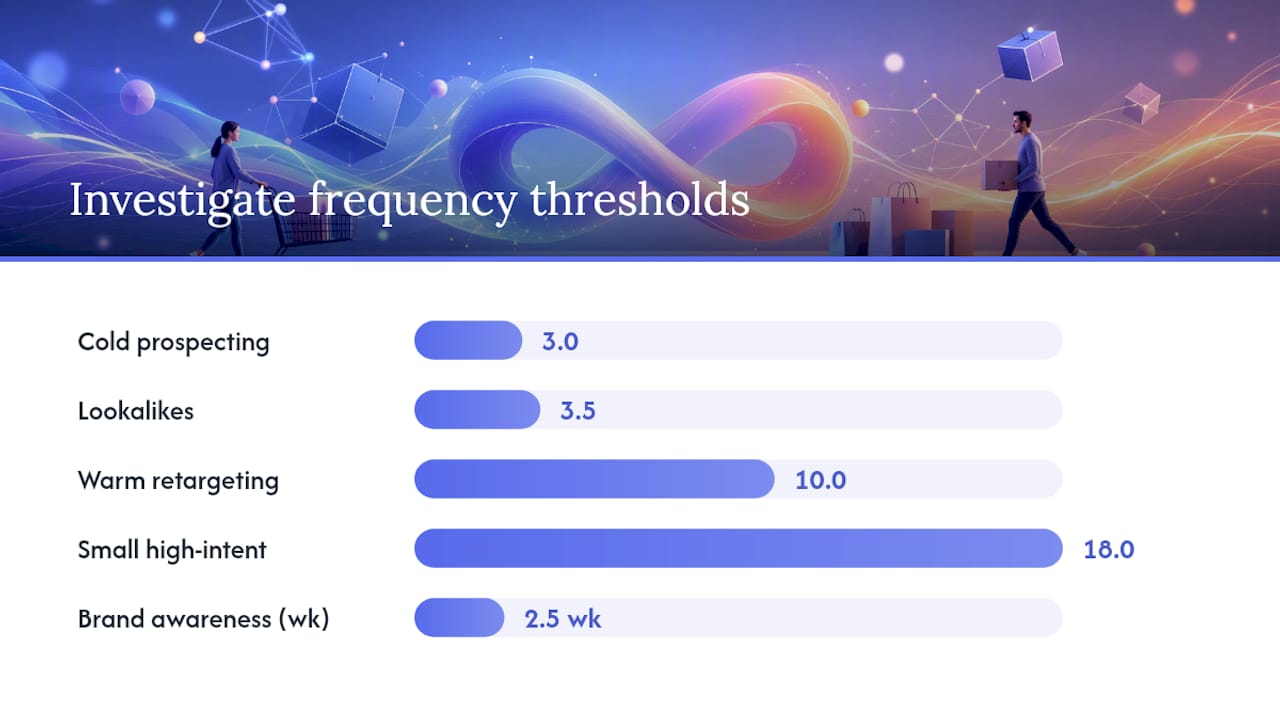
There’s no universal “good” number here, and anyone who gives you one flat threshold hasn’t managed enough accounts to know better. Practitioner benchmarks put prospecting campaigns at risk of performance decay above roughly 2.5 to 3.0, while warm retargeting audiences can often tolerate 5 to 15 depending on how much creative variety you’re running and how large the pool is.
| Campaign type | Typical healthy range | Investigate above |
|---|---|---|
| Cold prospecting (broad or interest-based) | 1.0 to 2.5 | 3.0 |
| Lookalike audiences | 1.5 to 3.0 | 3.5 |
| Warm retargeting (30 to 180 day windows) | 3.0 to 8.0 | 10.0 |
| Small high-intent lists (cart abandoners, past buyers) | 5.0 to 15.0 | 18.0 |
| Brand awareness / reach objective | 1.0 to 2.0 (weekly) | 2.5 (weekly) |
Treat every number in that table as a starting guardrail, not a rule. Audience size is the biggest variable: a retargeting pool of 5,000 people will naturally accumulate frequency faster than one of 200,000, and that speed isn’t automatically a problem. Creative variation matters just as much. Five ad variations rotating through an ad set stretch tolerable frequency further than a single static image, because the audience isn’t seeing identical stimuli each time.
Campaign duration compounds both. A prospecting campaign that’s been live for three weeks with no creative refresh will hit fatigue faster than one that’s two days old, even at the same frequency reading. When you see a number above the “investigate” column, that’s your cue to move to diagnosis, not your cue to panic or cap.
How to Diagnose Whether High Frequency Is Actually Hurting You
Work through this in order. Skipping steps is how people cap frequency on a campaign that was never actually broken.
- Check CTR trend over the last 7 and 14 days. A single day’s dip is noise. A consistent slide across two weeks, alongside rising frequency, is a real signal.
- Check CPA or ROAS trend over the same windows. If CTR is soft but CPA is stable, your creative might just be less “clicky” while still converting the clicks it gets.
- Check CPM. A rising CPM alongside falling CTR usually means the auction is charging you more for a weaker relevance signal. Rising CPMs are also worth cross-checking against broader why is CPM high explanations, since seasonality and competition can move CPM independent of your own frequency.
- Check reach growth. If reach has flattened while spend holds steady, you’re recycling the same people, which is exactly when frequency creep turns into fatigue.
- Check comment sentiment and negative feedback. Comments like “again?” or repeated ad hides are a blunt but honest fatigue signal Ads Manager won’t summarize for you.
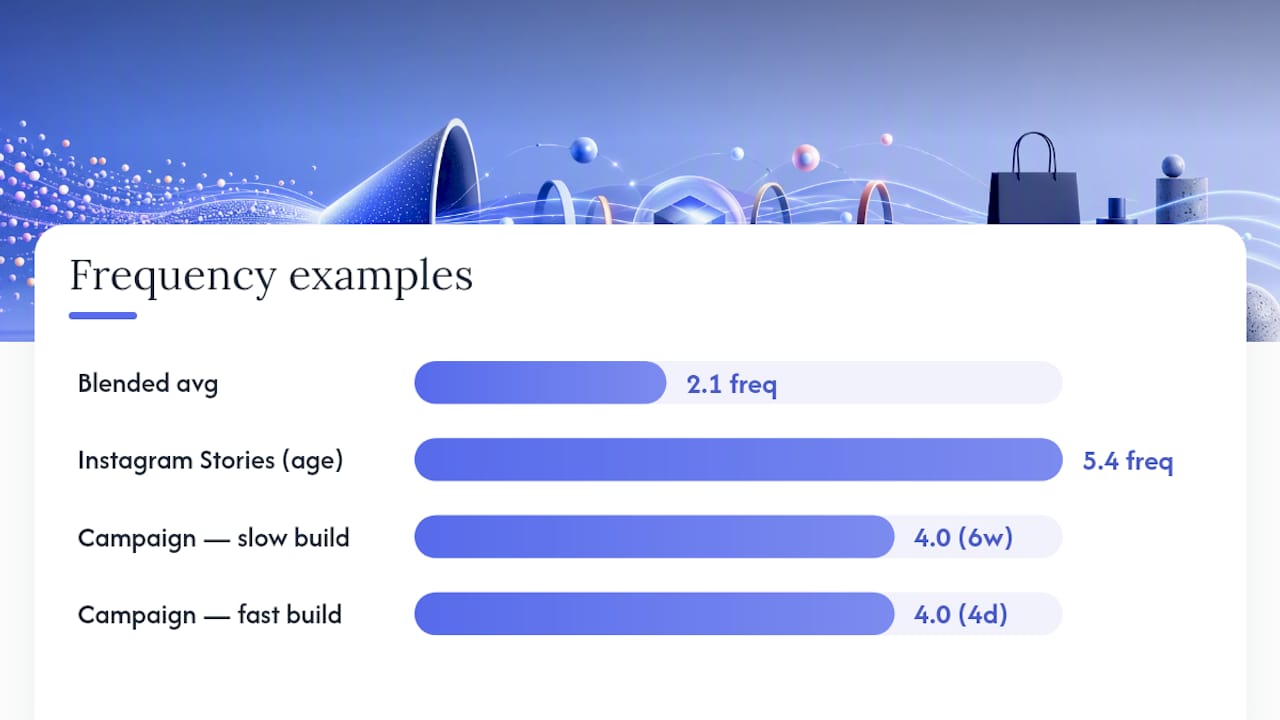
How fast frequency accumulates matters more than the number itself. A campaign that hits 4.0 over six weeks is a different situation than one that hits 4.0 in four days on the same budget. Fast builds usually mean your audience is too small for the spend behind it, which Advantage+ and broad targeting can quietly cause by narrowing delivery toward a responsive subset even when your stated audience is wide.
Break results out by placement and demographic before you touch anything. I’ve seen accounts where blended frequency looked fine at 2.1, but Instagram Stories alone was sitting at 5.4 for one age bracket. That’s not a campaign-wide problem. That’s one placement quietly burning budget while the rest of the account looks healthy.
Pro Tip: Pull a delivery breakdown by placement and age range before you decide anything. Blended averages routinely mask a single pocket of the audience absorbing double the frequency everyone else sees.
Tactics to Manage and Lower Facebook Ad Frequency
Work through fixes in order of speed. Don’t jump to structural changes before you’ve tried the fast ones, and don’t touch caps until you’ve exhausted both.
Fast fixes (same day):
- Refresh creative, even a simple variation swap, on the specific ad set showing decay.
- Pause the tired ad and shift budget to a newer variant already in rotation.
- Swap in a previously winning creative set that hasn’t run in the current cycle.
Structural fixes (this week):
- Expand or segment the audience so spend isn’t concentrated on the same pool.
- Adjust your budget-to-audience ratio. If you’re spending $200/day against a 15,000-person retargeting list, that’s the math problem, not the creative.
- Test dayparting to spread delivery across more hours rather than saturating the same active users repeatedly.
Operational controls (ongoing):
- Exclude recent converters so retargeting budget isn’t wasted on people who already bought.
- Build sequence creative for retargeting funnels, where each exposure delivers a different message beat instead of repeating the same one.
- Use short, intentional high-frequency bursts for launches or sales, where the goal is saturation rather than efficiency.
The creative rotation fix works faster than any account-level lever you have access to, in my experience running audits across DTC accounts. A frequency cap doesn’t fix a stale ad. It just slows down how often that stale ad gets shown, which caps your reach without solving the actual problem. If your creative pipeline is thin, that’s the real bottleneck, and a testing framework built for rotation will do more for your CPA than any setting inside Ads Manager.
Pro Tip: If you only have budget to fix one thing this week, fix the creative. A new ad variant usually recovers CTR within 48 to 72 hours; a frequency cap recovers nothing on its own.
Setting Frequency Caps in Meta Ads (and Their Limits)
Native frequency caps exist, but they don’t work the way most advertisers assume, and they don’t apply everywhere.
- Where caps are available: Meta’s reservation and reach buys support native frequency controls, along with the Brand Awareness and Reach objectives. You set a cap as a number of impressions over a defined time window, at the ad set or campaign level.
- What the setting actually does: it limits how often the same account sees the ad within your chosen window, typically expressed as impressions per day range, not a hard global ceiling on lifetime views.
- The conversions gap: most conversion-optimized campaigns, the ones running your prospecting and retargeting funnels, don’t support native frequency caps at all. The auction is optimizing for outcomes, and Meta doesn’t let you constrain delivery the same way.
- A common trap: caps often lock once an ad set is created. Third-party ad managers document the same immutability issue, so plan your cap before launch, not after you notice a problem.
- The practical workaround: since conversion campaigns can’t use native caps, audience segmentation, budget pacing, and automated rules do the job caps were built for, just with more control.
Caps make sense for awareness and reach buys, where Meta’s research on recall lift directly applies. For everything else, you’re managing frequency through audience design and creative supply, not a setting.
Monitoring Cadence and Automated Rules That Catch Fatigue Early
Manual checks work until the account scales past what you can eyeball daily. Set a cadence and stick to it.
- Daily checks for any account spending more than $50 a day. This isn’t optional past that threshold; fatigue compounds fast at real budget levels.
- Checks every 2 to 3 days during active scaling phases, when audience and budget are both shifting and frequency can spike faster than usual.
- A standing dashboard covering frequency, CTR, CPM, CPA, reach trend, and placement breakdowns, viewed together rather than one metric at a time.
- An automated rule that flags the real fatigue pattern: frequency above 2.5 combined with CTR down more than 15% versus the prior period. That combination catches decay before it becomes visible in blended reporting.
The point of pairing metrics in a rule, rather than watching frequency alone, is that frequency by itself lags the real signal. CTR moves first. A rule built on both catches the problem while it’s still cheap to fix, not after CPA has already climbed for a week. If you haven’t audited an account’s monitoring setup recently, a structured audit process will surface gaps faster than ad hoc dashboard checks.
How My Team at Cosma Handles Frequency Incidents
Frequency is a symptom, not a diagnosis. That’s the first thing I tell anyone on my team who flags a frequency spike, because reacting to the number itself, instead of what’s causing it, is how accounts end up over-capped and under-reached.
Our audit sequence, in order:
- Creative resonance first. Is the ad set actually stale, or is frequency just accumulating naturally on a small, high-intent audience? These look identical on a dashboard and require completely different fixes.
- Creative overlap check. Are multiple active ad sets showing the same or near-identical creative to overlapping audiences, effectively doubling exposure without anyone intending it?
- Spend-to-audience ratio. We calculate daily spend against audience size before touching anything else. A mismatch here explains most “sudden” frequency spikes.
- Time and placement breakdowns. We isolate which specific slice of the account, not the blended average, is actually driving the concern.
In the first 48 hours of an incident, the priority order is fixed: rotate creative, then check audience segmentation, then adjust budget pacing, then, only if none of that resolves it, consider a cap on an eligible objective. That sequence resolves the overwhelming majority of frequency complaints my team sees without ever touching a cap setting. The broader media plan behind an ecommerce account usually explains the root cause anyway: thin creative supply feeding a shrinking effective audience.
Building Frequency Discipline Into Your Creative Ops
The accounts that never panic about frequency are the ones that treat creative refresh as a scheduled input, not an emergency response. If your pipeline produces new variants every one to two weeks, frequency rarely gets the chance to become a real problem, because the audience never sees the same message long enough to tune it out.
Budget for that pipeline the way you budget for media spend, not as an afterthought squeezed in when performance dips. Build a recurring audit cadence, weekly for scaling accounts, into whatever process governs your account, and make frequency review part of the standing checklist rather than a reaction to a bad week. Put it in writing as part of how the account is run. Treat frequency monitoring as a line item in your campaign SLA, not a fire drill, and most of what this article covers becomes unnecessary to think about day to day.
— Stefano Mazzei
Get a Frequency and Creative Audit From My Team at Cosma
If you’ve read this far because a specific account is showing the fatigue pattern I’ve described, running the diagnosis yourself works, but it takes time you may not have this week. My team at Cosma runs frequency and creative audits daily for DTC and ecommerce accounts across the US and Canada, and we usually spot the actual bottleneck, thin creative supply, audience overlap, or a spend-to-audience mismatch, within the first pass.
A typical audit covers full diagnostics across your active ad sets, a prioritized list of fixes ranked by expected impact, and a 30/60/90 day plan for creative rotation and audience structure so the same fatigue pattern doesn’t resurface next quarter. You can see how this has played out for other brands in our case studies, or go straight to booking a session with my team to walk through your account directly.
Sources
- Frequency | Meta Business Help Center
- Choosing your frequency controls for a reservation campaign — Meta Business
- Facebook Ads Frequency - Metric Definition — Databox
FAQ
Why are Facebook ads so frequent now?
Rising CPMs and narrower effective audiences, especially under Advantage+ delivery, push the algorithm to concentrate impressions on smaller, more responsive segments, which raises frequency faster than advertisers often expect.
What is the 3-2-2 method for Facebook ads?
There’s no single standardized “3-2-2” framework backed by Meta or established industry documentation; if you’ve seen it referenced, treat it as one practitioner’s shorthand rather than a universal rule, and rely on the CTR-and-CPA-based diagnosis covered above instead.
Is $10 a day good for Facebook ads?
It depends entirely on your audience size and CPMs; $10 a day can work for a small, tightly targeted retargeting list but will hit high frequency fast on a small audience and won’t generate meaningful reach for cold prospecting.
What is the ideal posting frequency on Facebook?
For paid ads, Meta’s research shows one weekly exposure captures about 80% of available recall lift and two weekly exposures capture about 95% of purchase-intent lift, which makes a low weekly cap a reasonable target for awareness objectives specifically.
When should I actually worry about ad frequency?
Worry when frequency rises while CTR falls and CPA or CPM worsens over a consistent 7 to 14 day trend; a rising frequency number with stable performance metrics usually isn’t worth acting on.


