
Scale Spend Faster: 5-Pillar Creative Scorecard for DTC Brands
A creative scorecard is a repeatable rubric for scoring ad creatives on a handful of pillars, usually 1 to 5, before you launch spend and again during weekly review. Use it to triage new concepts, standardize how you compare agency or in-house work, and decide fast which creatives deserve more budget. The point is not the score itself. It’s forcing every creative decision to answer one question: can this scale to revenue?
TL;DR:
- A creative scorecard should quickly identify assets with weak hooks, unclear visuals, or poor offer clarity to prevent wasting ad spend.
- Focusing on business metrics like ROAS and CAC first ensures the creative drives revenue instead of just attention.
- Consistent naming, real-time data joins, and structured review processes are essential for scoring to influence actual decision-making.
- Automated tagging of creative elements becomes necessary at scale, as manual scoring cannot keep up with high-volume testing.
- Final ownership should involve the creative lead for scoring, the media buyer for validation, and the growth lead for scaling decisions.
Table of Contents
- What Goes Into a Practical Creative Scorecard
- Which Metrics Actually Matter (And In What Order)
- How to Run a Scorecard Inside Your Actual Workflow
- A Copy-Ready Scorecard You Can Paste Into Slack Today
- What My Team At Cosma Actually Prioritizes
- When a Scorecard Stops Being Enough
- If You Want Help Operationalizing a Creative Scorecard
- Sources
- FAQ
What Goes Into a Practical Creative Scorecard
A scorecard only works if it’s short enough to fill out in two minutes and specific enough that two different reviewers land within a point of each other. The Meta creative scorecard methodology from AdRoast builds this around five equally weighted pillars, and it’s the cleanest structure I’ve seen for pre-launch triage:
- Hook (the first few seconds): does it stop the scroll before the viewer knows what’s being sold?
- Visual clarity: is the product, offer, or main message legible in a silent, small-screen scroll?
- Offer readability: can someone explain what’s being offered after one viewing, no rewind?
- Proof or social proof: does the ad carry a review, number, demonstration, or credibility signal?
- CTA clarity: is there one unmistakable next action, not three competing ones?
Score each pillar 1 to 5. A 1 means the pillar is effectively absent. A 3 means it’s present but generic. A 5 means it’s the kind of execution you’d screenshot and show a client. Averages tell you what to do next: any single pillar scoring 1 or 2 should block launch outright, since a weak hook or unreadable offer sinks the whole asset regardless of how the rest scores. An average under 3 means rewrite before it ever sees spend. Scores above that suggest different testing intensities. That threshold structure keeps the scorecard from becoming a vague vibe check.
Which Metrics Actually Matter (And In What Order)
Most teams grade creative on attention. That’s backwards. Focal’s breakdown of creative performance KPIs puts business outcomes first and treats attention metrics as diagnostics, not verdicts. I run every account this way now: does the creative let you spend at volume with an acceptable ROAS, and does it hold CAC where the business needs it? Everything else exists to explain why.
| Tier | Metric | What it tells you |
|---|---|---|
| Business outcome | ROAS, conversions/CAC | Whether the creative earns its spend |
| Business outcome | AOV, LTV | Whether it attracts the right buyer, not just any buyer |
| Creative diagnostic | Hook rate (3-second view) | Whether the opener stops the scroll |
| Creative diagnostic | Hold rate | Whether the middle of the ad keeps attention |
| Creative diagnostic | CTR, CVR | Whether interest converts to intent, then purchase |
| Creative diagnostic | Frequency | Whether the creative is fatiguing the audience |
The useful move is reading mismatches, not single numbers. A creative with a strong hook rate but weak CVR usually has an offer or CTA problem, not a creative problem. A strong hook rate and hold rate that never translates into CTR points at a landing page or offer clarity gap further down the funnel. The diagnostic layer exists to tell you where in the creative to cut, not whether to kill it outright.
How to Run a Scorecard Inside Your Actual Workflow
A scorecard that lives in someone’s head dies the first time that person is on vacation. It needs structure around it.
- Name assets consistently. Every creative gets a naming convention that encodes concept, hook type, and version, so you can join creative IDs to conversion data without manual lookup.
- Track at the asset level, not the campaign level. Campaign-level averages hide which specific creative is carrying or dragging performance.
- Set a review cadence in three layers: pre-launch triage against the scorecard, a 24 to 72 hour live check once spend starts, and ongoing fatigue monitoring as frequency climbs.
- Assign ownership explicitly. The creative lead scores the asset. The media buyer validates the metrics against spend data. The growth lead makes the scale or kill call.
Structured naming and real-time joins between creative IDs and conversions are what separate a scorecard that actually drives decisions from one that’s a nice document nobody opens after week one.
Pro Tip: Run the 24 to 72 hour check before you touch budget allocation. A creative that looks strong on hook rate in the first 12 hours can still be masking a weak CTA that only shows up once volume increases.
A Copy-Ready Scorecard You Can Paste Into Slack Today
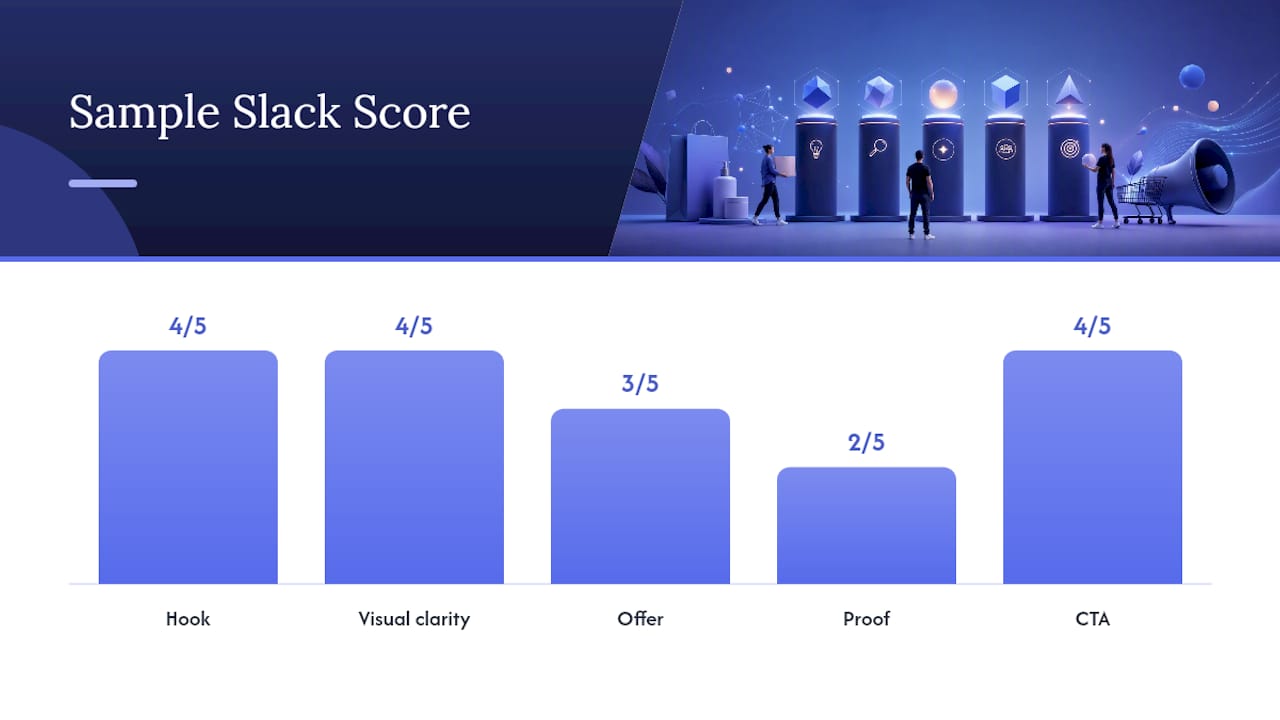
You don’t need software to start. AdRoast’s methodology is explicitly built to run in a Slack huddle, and that’s genuinely how I use a version of it with creative teams before anything goes live.
Paste this into a channel or brief:
- Reviewer instructions: Score each pillar 1 to 5. Any 1 or 2 blocks launch. Average the five scores.
- Hook (1 to 5): Does it stop the scroll in 3 seconds?
- Visual clarity (1 to 5): Is the message clear on mute, on a small screen?
- Offer (1 to 5): Can you repeat the offer after one view?
- Proof (1 to 5): Is there a credible signal, not just a claim?
- CTA (1 to 5): Is there one obvious next step?
A sample scored row might read: Hook 4, Visual 4, Offer 3, Proof 2, CTA 4, average 3.4, verdict “small test.” Record verdicts directly in your asset-level naming system so scores stay attached to the creative, not buried in a chat thread.
What My Team At Cosma Actually Prioritizes
We built our internal version of this scorecard around one rule: no creative gets called a winner until it’s joined to revenue, not just clicks. Hook rate and CTR earn a creative a bigger test budget. Only ROAS and CAC earn it real scale.
The biggest fix we make for new clients isn’t a creative problem at all. It’s that their creative IDs were never joined to their conversion data in the first place, so every “winning ad” conversation was really a guess dressed up as an insight.
Before we score anything, we confirm the data join works. Pro Tip: If your ad platform and your attribution or CRM system can’t reliably match on creative ID, fix that plumbing before you invest another hour in scoring rubrics; it’s the constraint that makes everything downstream unreliable. This connects directly to how I think about structuring a performance creative framework around outcomes rather than opinions.
When a Scorecard Stops Being Enough
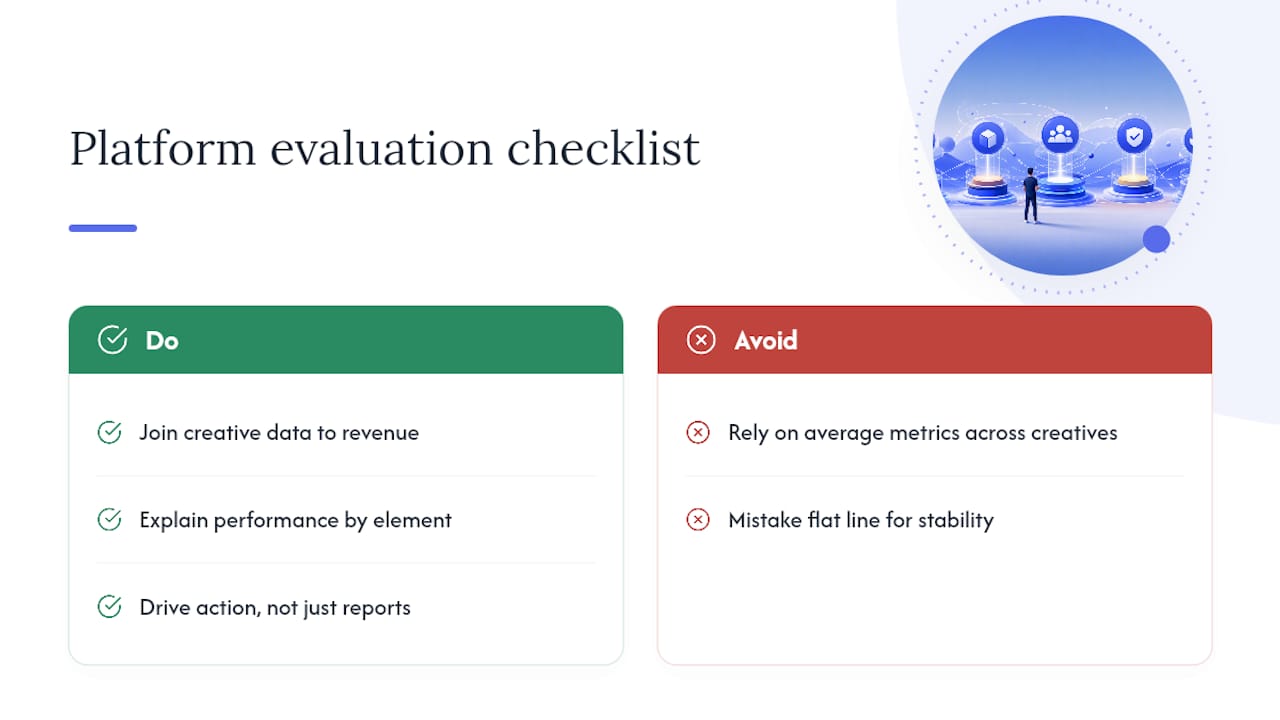
Human scoring works well up to a point, roughly the volume one or two reviewers can score in a weekly cadence without fatigue setting in. Past that, you need automated tagging that maps creative elements to revenue at scale. Creative analytics platforms do this by tagging elements like hook type, color, or CTA style, then linking those tags to metrics like ROAS.
Before buying any platform, check three things: does it join creative data to actual revenue, does it explain performance at the element level rather than just ranking whole ads, and does it drive an action, not just a report? The most common trap I see is teams staring at average metrics across dozens of creatives and mistaking a flat line for stability, when three creatives are quietly funding the other twenty.
— Stefano Mazzei
If You Want Help Operationalizing a Creative Scorecard
Building the rubric is the easy part, especially when you leverage AI for marketing teams to plan, write, and launch faster. The harder part is wiring it into a real testing operation: consistent naming, clean creative ID joins, and a review cadence your team actually follows once spend gets real. That’s the gap my team at Cosma closes for DTC and ecommerce brands scaling in the U.S. and Canada.

We run creative testing ops, build the asset-level tracking infrastructure most brands are missing, and pilot the scorecard against your actual account data before recommending anything permanent. A typical engagement starts with an audit of your current creative and tracking setup, moves into a pilot test against a small set of concepts, then rolls into a full roadmap once we know which pillars are actually costing you revenue. You can see examples of the creative work behind this in our portfolio and the results from past engagements in our case studies. If you want to talk through where your creative process is leaking performance, book time with my team or check pricing to see what a pilot looks like.
Sources
The rubric and threshold logic in this article draws directly from AdRoast’s Meta creative scorecard methodology, which lays out the five-pillar scoring system in full. For the KPI hierarchy argument, Focal’s guide to creative performance KPIs is worth reading end to end. Teams ready to move past manual scoring should study Segwise’s guide to creative analytics for how element-level tagging works at scale.
- Meta Creative Scorecard Methodology
- The creative performance KPIs that matter most in 2026
- Creative Analytics: The Complete 2026 Guide | Segwise
FAQ
What Is a Creative Scorecard Used For?
It’s used to triage ad creatives before launch and during review, scoring pillars like hook, visual clarity, offer, proof, and CTA on a 1 to 5 scale to decide whether to kill, fix, test, or scale each asset.
What Metrics Should A Creative Scorecard Track First?
Business outcomes come first: ability to spend at volume, ROAS, and conversions or CAC. Creative diagnostics like hook rate, hold rate, and CTR come second, used to explain why the business metrics look the way they do.
How Often Should You Review A Creative Scorecard?
Score creatives before launch, check them again 24 to 72 hours after spend starts, and monitor ongoing fatigue as frequency climbs, especially once a creative has been live more than a week.
Can A Creative Scorecard Replace Creative Analytics Software?
Not past a certain volume. Manual scorecards work well for a handful of reviewers and a manageable weekly creative load, but teams running hundreds of creatives need automated tagging that joins elements to revenue directly.
Who Should Own The Creative Scorecard In A Team?
The creative lead scores the asset against the rubric, the media buyer validates those scores against real spend and conversion data, and the growth lead makes the final call on whether to scale.


