15 Minute Reference Set: Testable Ad Creative Brief for DTC Teams
An ad creative brief is a one-page document that turns a marketing objective into a testable creative bet, with one owner, one audience insight, one falsifiable angle, and one metric that decides if the bet worked. Its single job is to stop the guessing between strategy and production. If your brief can’t answer “what are we testing and how will we know” in under 90 seconds, it isn’t doing its job yet.
TL;DR:
- A concise creative brief must clearly define a testable hypothesis, specific target metric, and audience insight to prevent costly revisions later.
- Attaching three to five in-market reference ads with notes on their strengths helps establish a factual foundation for the angle hypothesis and creative direction.
- Platform-specific specs such as aspect ratios, runtime limits, and mandatory legal disclosures should be detailed to avoid technical reworks and rejection risks.
- Including legal, compliance, and platform guidelines upfront ensures the creative assets meet regulations and policy standards, preventing rejection post-production.
Table of Contents
- What Is an Ad Creative Brief and Why Does It Matter?
- Core Components: A One-Page Ad Creative Brief Template
- Research-First Workflow and How to Build the Reference Set
- Platform Format Specs and Guardrails to Include in the Brief
- How to Write an Ad Creative Brief in Under an Hour
- Three Short Example Briefs You Can Adapt Today
- Common Mistakes That Force a Second Draft
- Handoff, Approvals, and Closing the Loop on Results
- Legal and Compliance Considerations in Ad Creative Briefs
- My Perspective: How I Use Briefs at Cosma and What I Prioritize
- Sources
- FAQ
What Is an Ad Creative Brief and Why Does It Matter?
The brief is the control surface between strategy and production. Everything downstream, the hooks, the storyboard, the static layout, gets built against what this document says. Skip the rigor here and you pay for it later in revision rounds, not in the brief itself.
Brevity is the whole point. A research-first template built around a falsifiable angle hypothesis reduces wasted creative spend because it forces the strategist to commit to one bet instead of hedging across five messages. I use what I call the stranger test: hand the brief to someone outside the project. If they can’t explain the objective, the audience, and the bet in one read, the brief needs another pass before it goes anywhere near production.
Multiple sources converge on the same length rule. Longer documents usually signal unresolved strategy, not thoroughness, and they tend to increase review cycles rather than prevent them.
On most teams, four roles touch the brief:
- Strategist or media buyer writes the objective, audience insight, and angle hypothesis.
- Creative owner (designer, editor, or UGC lead) turns the brief into assets.
- Approver (brand manager or CMO) signs off on mandatories and claims before production starts.
- Performance lead sets the success metric and confirms it’s trackable before the brief ships.
Core Components: A One-Page Ad Creative Brief Template
Every field in the brief exists to prevent a specific kind of rework. Cut one and you’ll feel it in the revision round.
- Objective with a measurable target. Not “drive sales.” A number: CPA under $28, ROAS above 2.5, or CTR above 1.2%. Without a target, nobody can tell if the creative won or lost.
- Audience and mindset. Who sees this ad, and what are they doing the moment it appears? Scrolling past a competitor’s product page reads differently than watching a Reel for entertainment.
- Angle hypothesis. Written as a claim you can prove wrong: “Showing the product failing before it works will out-thumbstop a clean unboxing.” A message like “highlight durability” isn’t testable. A bet is.
- Reference set. Three to five in-market ads with a one-line note on why each earns its place. This field alone separates a brief that reads as a testable bet from a wish list.
- Format and specs. Placements, aspect ratios, runtime ceilings, file types. Get this wrong and the creative owner builds the wrong shape twice.
- Success metric and secondary reads. One number decides the bet. Everything else is context, not the verdict.
- Deadline, revision loop, mandatories, and claims. Legal copy, disclaimers, and required brand elements belong here, spelled out, not implied.
This structure lines up closely with the AMA’s own creative brief template, which builds around project summary, audience definition, messaging guidance, and deliverables. The difference in a performance-creative brief is the angle hypothesis field. Where the AMA version asks for messaging guidance, a performance brief asks for a claim you can disprove with data.
Research-First Workflow and How to Build the Reference Set
Most creative briefs skip research and go straight to opinion. That’s backwards. The reference set should come before the angle hypothesis, not after, because the ads already working in your category tell you more than a whiteboard session ever will.
Here’s the 15-minute version I run before writing anything:
- Pull the category (0 to 5 minutes). Search competitor and adjacent-category ads live right now. Focus on what’s still running, since active spend signals it’s working.
- Group by angle (5 to 10 minutes). Cluster what you find into buckets: proof-based, problem/agitation, founder-story, comparison. Patterns show up fast.
- Select three to five references (10 to 15 minutes). Pick the strongest example from each cluster, not five variations of the same idea.
Annotate each reference with why it earns its spot: does it win on the thumbstop, the hook line, or the proof moment? That one-line note is what turns a screenshot folder into a usable input for the angle hypothesis field, an approach the research-first brief format is built around specifically to make angles falsifiable instead of vague.
Format matters here more than people expect. For vertical video like Reels, your reference set needs to be vertical-only; a square or landscape reference misreads pacing and thumbstop timing completely. Static references for a Feed or Display placement don’t transfer either. Match the reference format to the deliverable format before you annotate a single ad.
Pro Tip: Keep a running swipe folder by angle cluster, not by brand. When you need a reference for a “proof-based” angle next month, you want ten examples sorted and ready, not a scroll through six months of screenshots.
Platform Format Specs and Guardrails to Include in the Brief
Technical rework is avoidable rework. Most of it traces back to specs and policy flags that should have lived in the brief from the start.
- Image and video specs. Aspect ratios (1:1, 4:5, 9:16), runtime ceilings, and approved file types vary by placement, and getting one wrong means a reshoot, not a quick fix.
- Overlaid text and clarity. Google’s guidance for responsive display ads recommends minimal overlaid text, high-quality images, and multiple asset variants per ad group, generally three to four, to protect eligibility and performance.
- Sentence case and a clear call-to-action. Small formatting choices affect both approval speed and how the ad reads on a crowded feed.
- Platform-specific policy flags. Microsoft Advertising’s creative guidelines specify approved formats like JPEG, PNG, GIF, and HTML5, along with rules around redirects, local storage, and mandatory political-ad declarations in certain cases. Miss one of these and the ad gets rejected after production, not before.
Where the industry agrees: IAB’s creative best-practice guidance lists five core principles: focus on the objective, understand the audience, produce multiple assets for different devices, keep branding and key messages clear, and invest in measurement. When platform specs conflict with your default template, attach a one-page appendix rather than rewriting the main brief. It keeps the core document readable while giving production what it needs.
How to Write an Ad Creative Brief in Under an Hour
A brief doesn’t need a week. It needs a clear process and a checklist that stops a weak brief before it reaches production.
- Minutes 0 to 15: pull references. Run the 15-minute reference workflow above. Don’t skip this to save time; it’s the step that makes the angle testable.
- Minutes 15 to 35: fill the fields. Objective, audience and mindset, angle hypothesis, format and specs, success metric, deadline. Write in full sentences, not fragments; ambiguity here is what triggers questions later.
- Minutes 35 to 45: author review. Read it back using the stranger test. Would someone outside the project understand the bet without a follow-up call?
- Minutes 45 to 60: deliver. Send the brief with the reference set attached as images or links, not descriptions.
Before it ships, run it against this checklist:
- Objective has a number attached, not just a direction.
- The brief states one key message, not three competing ones.
- Three to five references are attached with notes.
- Format and specs are complete for every placement in scope.
One decision rule simplifies most disagreements about what belongs where: if a detail affects how the ad is judged (the bet, the audience, the metric), it stays in the brief. If it affects how the ad is built (exact crop, font weight, brand color hex), it belongs in an attached style guide instead.
Three Short Example Briefs You Can Adapt Today
Acquisition (cold audience, Meta Reels). Objective: CPA below a specific target. Audience: scrolling entertainment mindset, no brand familiarity. Angle hypothesis: a testable claim that a specific hook style performs better for the targeted audience. Reference note: an in-market ad exemplifying effective early engagement through relatable content. Format: appropriate aspect ratio and runtime ceiling matching platform requirements. Success metric: a clearly defined performance metric measured after a specific test period.
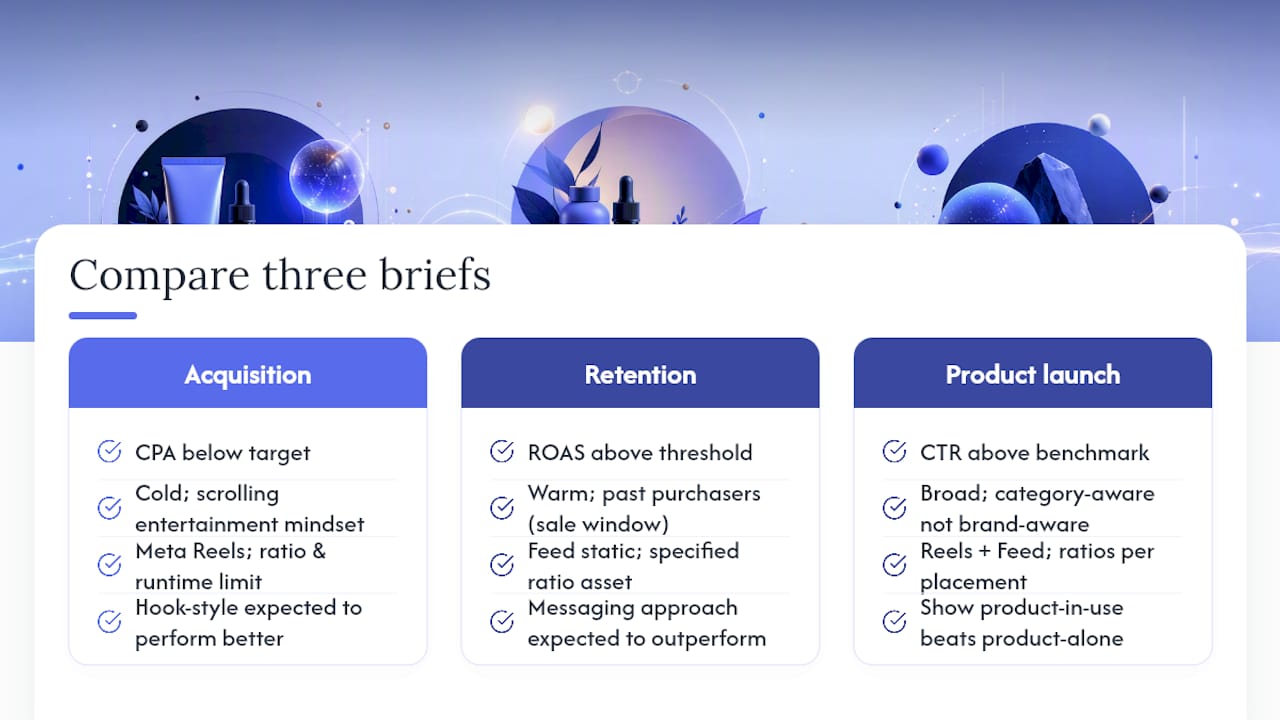
Retention (warm audience, Feed static). Objective: ROAS target set above a specified threshold. Audience: past purchasers, browsing during a sale window. Angle hypothesis: a specific messaging approach expected to outperform alternatives. Reference note: example demonstrating effective headline reuse from related marketing materials. Format: specified aspect ratio and static asset type per placement guidelines. Success metric: targeted ROAS measured after a defined evaluation window.
Product launch (broad audience, Reels and Feed). Objective: aiming for a click-through rate exceeding a set benchmark. Audience: category-aware, not brand-aware. Angle hypothesis: showing the product in use beats showing the product alone. Reference note: naming conventions applied across three format variants for clean tracking. Format: aspect ratios matched to placement requirements for Reels and Feed respectively. Success metric: CTR measured after an appropriate campaign duration.
Common Mistakes That Force a Second Draft
Most rework traces back to five habits, and they’re all avoidable at the brief stage.
- Long brand history instead of a bet. Nobody in production needs three paragraphs of company background to build an ad.
- Unfalsifiable messaging. “Highlight our quality” can’t be tested. “Showing a stress-test beats a product shot” can.
- Missing references. Without them, the creative owner is guessing at tone and pacing.
- Vague metrics. “Drive engagement” isn’t a metric. Pick a number.
- Missing rights or mandatories. Usage rights on UGC, required disclaimers, and legal copy need to be flagged before, not during, production.
Pro Tip: Run every brief through a nine-point gate before it leaves your desk: stranger test passed, measurable objective, single key message, references attached, format specs complete, success metric named, mandatories listed, deadline set, and approver named. Nine checks, thirty seconds each.
Handoff, Approvals, and Closing the Loop on Results
A 15-minute delivery call beats a brief sent cold every time. Walk the strategist, creative owner, and approver through the angle and references live; this single step prevents the most common source of rework, a misunderstood angle or a misread reference.
- Cap approval rounds at two. More than two rounds usually means the brief itself was unclear, not that the creative missed the mark.
- Version everything. Use a consistent naming convention so reporting stays legible once six variants are live.
- Record the single metric result. Note what beat the target and what didn’t, then feed that into the next angle hypothesis instead of starting from zero.
Legal and Compliance Considerations in Ad Creative Briefs
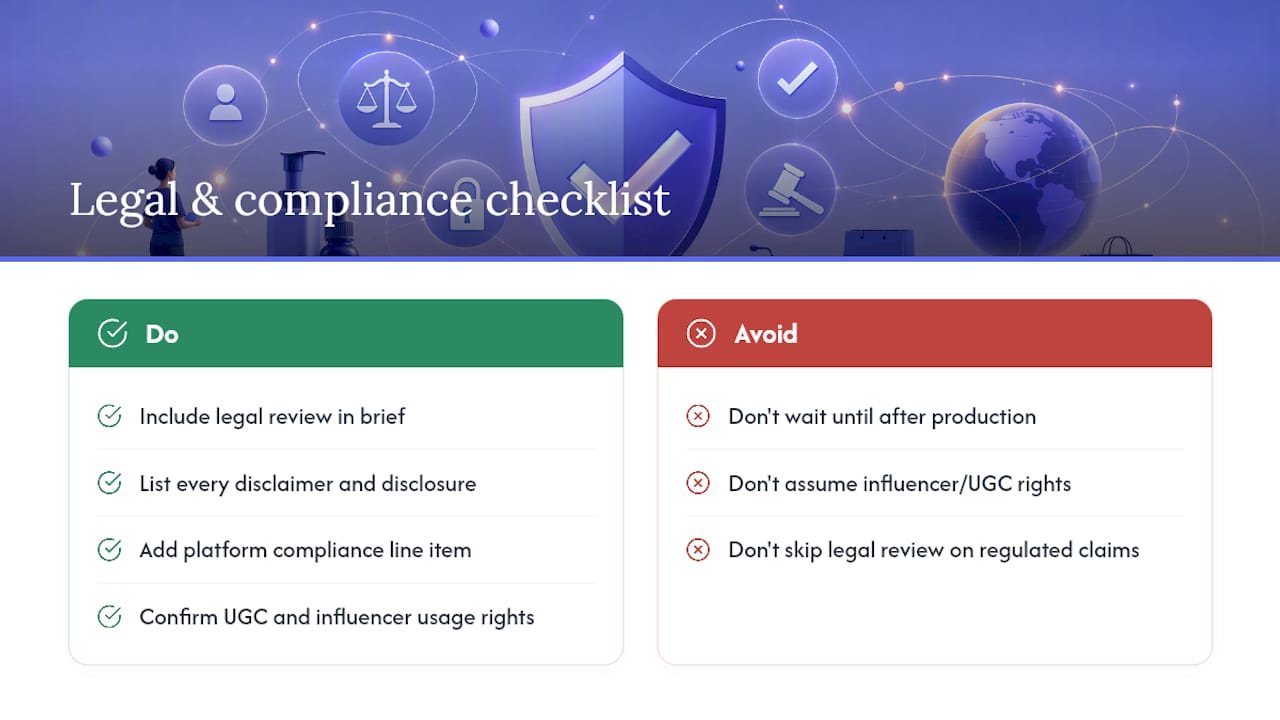
Legal review belongs in the brief, not as an afterthought after production wraps. The mandatories field should name every disclaimer, required disclosure, and usage right the creative must carry, sourced from your legal or compliance team before the brief goes to a creative owner.
Platform-level compliance deserves its own line item. Microsoft Advertising requires political-ad declarations in certain cases, and similar disclosure rules apply across Meta and Google depending on category and market. If your product touches health claims, financial services, or regulated categories, flag it in the brief so the creative owner doesn’t build something that gets rejected at review.
UGC and influencer content carries its own risk. Usage rights, whether the brand can run the content as a paid ad and for how long, need to be confirmed and stated in the brief’s mandatories field, not assumed. The same goes for music licensing on video assets and any third-party imagery.
None of this replaces a real legal review for claims that touch health, financial outcomes, or regulated products. Treat the brief’s compliance field as a flag for legal to review, not a substitute for that review. When in doubt, route the brief through whoever owns compliance before it reaches a creative owner’s desk, not after the first draft is built.
My Perspective: How I Use Briefs at Cosma and What I Prioritize
I’ve come to treat the angle hypothesis as the entire brief. Everything else is scaffolding. My team at Cosma pulls references first, always, because a bet grounded in what’s already working beats a bet grounded in a brainstorm. One change I’d push on any team today: stop writing “test the messaging” and start writing the specific claim you expect to win. If you want a second set of eyes on your creative process, my team and I at Cosma work through exactly this with e-commerce brands scaling paid acquisition.
— Stefano Mazzei
Sources
- AMA Creative Brief Template
- Best practices guide for responsive display ads - Google Ads Help
- Creative guidelines and specifications | Microsoft Learn
- Creative Brief 2026: The Research-First Template
FAQ
What Are the Core Sections of a Creative Brief?
A solid brief covers objective, audience and mindset, angle hypothesis, reference set, format and specs, success metric, and deadline with approval rounds. Some versions add mandatories and claims as an eighth field for legal and brand compliance.
What’s the Difference Between a Marketing Brief and a Creative Brief?
A marketing brief covers the full campaign, budget, channels, timeline, and business goals. A creative brief narrows in on one execution: the specific audience, angle, and asset that production needs to build.
How Do You Write a Creative Brief for Google Ads?
Follow the same core fields, objective, audience, angle, but add Google-specific asset requirements: multiple image and headline variants, minimal overlaid text, and a landing page that matches the ad’s promise, per Google’s own guidance.
Can a Creative Brief Be Too Long?
Yes. A brief that runs past one page usually signals unresolved strategic decisions rather than added rigor, and it tends to slow down production instead of speeding it up. Attach technical specs as a separate appendix instead of expanding the core document.


