
Broad Targeting Ecommerce: Why It Should Be Your Default
Broad Targeting Ecommerce: Why It Should Be Your Default
For mature DTC and ecommerce accounts, broad targeting through Advantage+ should be your default prospecting approach. The reason is simple: Meta’s ranking system, known internally as Andromeda, optimizes toward creative and pixel signals, not the interest stacks advertisers used to hand-pick. It finds buyers faster than you can guess who they are.
That said, broad targeting isn’t universal. Skip it if:
- Your account converts fewer than 50 times a week.
- You run niche B2B, hyperlocal, or Special Ad Category campaigns (housing, credit, employment, politics)
- You lack enough creative volume to feed the algorithm’s testing appetite.
Key Takeaways
Broad targeting works because Meta’s Andromeda ranking system reads creative and pixel signals more accurately than any manually chosen interest category.
| Point | Details |
|---|---|
| Default to broad at scale | Mature accounts with steady conversion history should treat Advantage+ broad as the starting approach, not the experiment. |
| Hit volume thresholds first | Aim for roughly 50 conversions per ad set per week before trusting broad campaign data. |
| Watch the exceptions | Low-volume accounts, niche B2B, and hyperlocal services often need seeded or hybrid targeting instead. |
| Creative is the real targeting | Test 5 to 8 variations with hook-first video, since weak creative throttles reach in a broad setup. |
| Get hands-on help | My team at Cosma builds the Meta Ads strategy and creative testing systems that make broad campaigns scale profitably. |
Table of Contents
- What Is Broad Targeting in Ecommerce, and How Did Advantage+ Change It?
- Why Broad Targeting Usually Beats Interest Targeting for DTC Brands
- When Broad Targeting Is the Wrong Move
- How to Set Up a Broad Campaign on Meta Without Wasting Spend
- Budgets, Learning-Phase Thresholds, and Structuring for Scale
- Testing Creative and Reading the Right Metrics When Your Audience Is Broad
- How to Migrate From Seeded Audiences to Fully Broad Targeting
- Why I Trust the Algorithm Over Manual Targeting for Mature Accounts
- How My Team at Cosma Helps You Scale Broad Campaigns Without the Guesswork
- Where to Verify These Platform Details Yourself
- Sources
- FAQ
What Is Broad Targeting in Ecommerce, and How Did Advantage+ Change It?
Broad targeting means you give Meta almost nothing to work with beyond country, age range, and gender. No interest stacks, no lookalikes, no behavior filters. You leave detailed targeting blank and let the system find buyers using signals from your creative and your Meta pixel.
This isn’t the same as Advantage Detailed Targeting, which expands a targeting selection you’ve already made when Meta thinks it will improve results, or Advantage+ Audience, which treats hard controls (age minimums, location, exclusions) differently than “suggestions” like interests and lookalikes. Some optimization goals enable this expansion automatically, and depending on the objective, you can’t always opt out.
- Legacy detailed targeting: you pick interests/behaviors manually.
- Advantage Detailed Targeting: your picks become a starting point, not a boundary.
- Broad/Advantage+ Audience: no interest inputs at all. Andromeda decides who sees the ad based on creative quality and pixel-driven purchase signals.
Why Broad Targeting Usually Beats Interest Targeting for DTC Brands
Broad campaigns tap into audience pools that are significantly larger than tightly filtered interest sets, which drives down your cost of reaching attention. Lower CPMs compound: cheaper impressions plus a smarter buyer model equals a lower blended CPA, even before you touch creative.
The mechanism matters more than the marketing pitch. Once your pixel has enough purchase events, Meta’s model builds a probabilistic buyer profile that’s more accurate than any interest category you could type into Ads Manager. An “interest in running shoes” checkbox is a rough proxy. Hundreds of actual purchase events are ground truth.
Statistic Callout: Broad campaigns have outperformed detailed targeting in the majority of Meta tests run since 2023, with reported gains including 29% more purchases, 17% cheaper cost per acquisition, and 19% higher click-to-purchase rates on video, according to testing data compiled by Ad Library.
Results like that aren’t universal, but the direction is consistent enough that I treat broad as the starting hypothesis for any account with real conversion volume, not the experiment.
Pro Tip: Don’t judge a broad campaign on day three. Andromeda needs a real sample of purchase events before its model stabilizes, so premature “it’s not working” verdicts usually kill campaigns right before they would have turned a corner.
When Broad Targeting Is the Wrong Move
Broad isn’t a universal fix. It fails in predictable situations, and knowing them upfront saves you a wasted testing cycle.
- Low conversion volume. Under roughly 50 purchases a week, the algorithm doesn’t have enough signal to build a reliable buyer model, so it defaults to something closer to random delivery.
- Narrow B2B or regulated campaigns. Special Ad Categories covering credit, housing, employment, and politics restrict how much Meta can use demographic and interest data, which limits how “broad” broad can actually be.
- Hyperlocal businesses. A single-location service business with a five-mile radius doesn’t have the population density to let broad targeting find enough qualified buyers. Use tight location controls, or a hybrid setup that seeds the algorithm with a small interest-based test before opening it up.
How to Set Up a Broad Campaign on Meta Without Wasting Spend
Here’s the checklist I hand to every new client account before we launch a broad prospecting campaign:
- Pick the right optimization event. Purchase, not Add to Cart or Landing Page View, unless you’re deliberately building a mid-funnel signal.
- Link your product catalog if you’re running Advantage+ Shopping Campaigns, since ASC pulls from catalog and pixel data to allocate spend dynamically.
- Set age wide. Default to 18 to 65+, unless you have hard evidence your buyer skews younger or older.
- Set gender to All unless your product is genuinely gender-specific.
- Set location to your real service geography, and leave detailed targeting blank entirely.
- Enable Advantage+ placements (or automatic placements) so Meta can shift delivery across Feed, Reels, and Stories based on where conversions actually happen.
- Launch 5 to 8 creative variations, mixing video and static, with distinct hooks and thumbnails.
Pro Tip: Front-load hook-first video, six to fifteen seconds, testing a different opening line or visual in each variant. Andromeda leans on early creative signals to decide who gets shown the ad, so a weak hook throttles your reach before the algorithm even gets to your offer.
Budgets, Learning-Phase Thresholds, and Structuring for Scale
The single most common mistake I see is pulling the plug on a broad campaign before it’s had a fair shot. Aim for roughly 50 conversions per ad set per week before you trust the results you’re seeing. That’s the point where Meta’s own documentation suggests the model has enough signal to stop guessing.
Budget zones roughly break down like this:
- Transition zone ($50 to $500/day): enough to test broad against a manual campaign, not enough to fully trust the data yet.
- Scale sweet spot ($500 to $2,000/day): where most DTC brands see broad’s advantages, lower CPMs and larger pools, start compounding.
- Enterprise scale ($2,000+/day): requires tighter creative refresh cycles and dedicated budget for Advantage+ Shopping Campaigns alongside a separate retargeting structure.
Structurally, I run broad prospecting through Campaign Budget Optimization or Advantage+ Shopping Campaigns, and I keep retargeting in its own campaign entirely. Mixing the two defeats the purpose of dynamic allocation, since the algorithm will happily spend your prospecting budget re-showing ads to people who already bought.
Testing Creative and Reading the Right Metrics When Your Audience Is Broad

When you strip out interest targeting, your creative becomes the targeting mechanism. A weak hook or a confusing product shot doesn’t just underperform, it actively tells Andromeda to stop showing your ad to the people most likely to buy.
Watch these signals closely:
- CTR and thumb-stop rate as your earliest read on whether a hook is working.
- CVR and CPA to confirm the click is translating into a sale, not just curiosity.
- ROAS at the campaign level, not just per creative, since broad campaigns reallocate spend fast.
- Pixel and event health in Events Manager, because a broken or delayed purchase event will quietly wreck a broad campaign’s learning.
Statistic Callout: Independent long-form analyses of mature ecommerce accounts show a common budget split of roughly 70 to 80% broad, 10 to 20% retargeting, and 5 to 10% reserved for seeded creative tests, according to comparative research from LaFactory.
Use Meta’s Ad Library to benchmark what competitors and category leaders are running creatively, then run controlled A/B tests, same budget, same optimization event, only the creative variable changed, so you’re comparing apples to apples.
How to Migrate From Seeded Audiences to Fully Broad Targeting
Most accounts shouldn’t flip a switch overnight. Start with a small lookalike or interest-based test to seed the pixel, and let it run until you’ve logged roughly 50 to 100 conversions in a 7 to 14 day window.
- Seed the account with a lookalike or narrow interest test if you’re starting from zero conversion history.
- Watch for the flip signal: stable CPA and consistent weekly conversion volume mean the pixel has enough data to hand the reins to broad.
- Troubleshoot spikes in CPA by checking creative fatigue first, then placement restrictions, then pixel event accuracy, then whether your daily budget is actually large enough to exit learning.
Why I Trust the Algorithm Over Manual Targeting for Mature Accounts
I’ve watched the shift from interest-stacking to algorithm-first targeting play out across dozens of ecommerce accounts, and the pattern holds: once an account has real conversion history, manual audience engineering adds friction, not precision. The model simply has more data than any human targeting guess.
At Cosma, my team splits budgets the way the data suggests, majority broad, a defined slice for retargeting, and a smaller reserve for creative experiments, then we let performance decide how those percentages shift over time. If you want to see how that plays out in practice, our case studies walk through real account structures.
— Stefano Mazzei
How My Team at Cosma Helps You Scale Broad Campaigns Without the Guesswork
The hard part of broad targeting isn’t flipping the setting, it’s building enough creative volume and reading the metrics correctly once you do. Most brands stall out here: they turn on Advantage+, run two ad variations, and quit after five days when CPA looks rough.
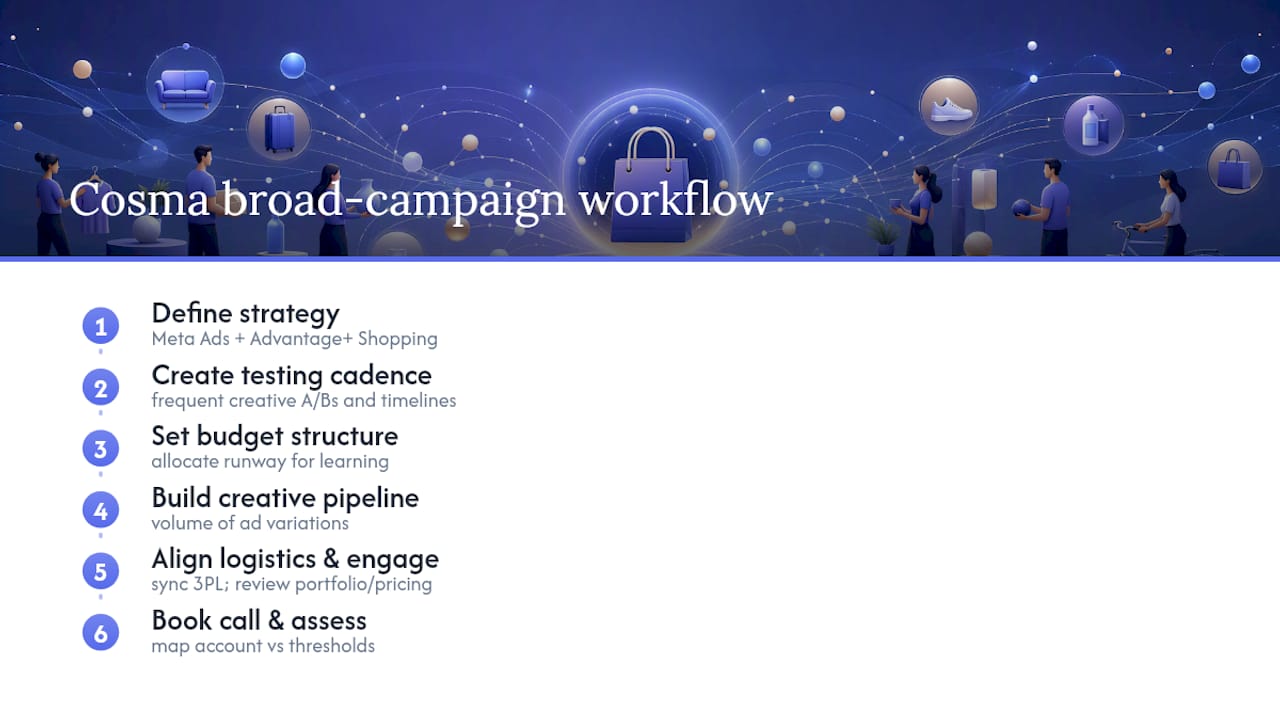
My team at Cosma runs Meta Ads strategy, Advantage+ Shopping implementation, and creative testing for DTC and ecommerce brands across the U.S. and Canada. We build the testing cadence, the budget structure, and the creative pipeline so your broad campaigns actually get the runway they need to work. If you’re coordinating fulfillment alongside a scaling push, it’s worth aligning your logistics with a resource like The 3PL Cowboy so inventory doesn’t become the bottleneck once ad spend climbs.
If you want a look at what this looks like in execution, browse our portfolio or check pricing for consulting engagements. When you’re ready to talk specifics, book a call and we’ll map out where your account stands against the volume and budget thresholds covered above. For deeper frameworks and creative breakdowns between now and then, Stefanomazzei has the full library.
Where to Verify These Platform Details Yourself
Meta’s own Facebook Business help center documents current best practices for broad reach and placement settings, and it’s the first place to check when Meta quietly changes a default. For configuration walkthroughs on Advantage+ Detailed Targeting opt-in behavior, Jon Loomer’s breakdown is the most detailed independent source I’ve found, and Sprinklr’s help documentation covers the platform-level constraints on Special Ad Categories in plain terms.
Sources
- Broad Targeting on Meta Ads (2026): Why the Algorithm Wins
- broad-targeting — AdAdvisor docs
- Advantage Detailed Targeting Updates - Jon Loomer Digital
- Meta Advantage+ Detailed Targeting — Sprinklr help
FAQ
What Does “Broad Audience” Mean in Meta Ads?
A broad audience means you’ve set only basic parameters, country, age range, gender, and left detailed targeting (interests, behaviors, lookalikes) blank so Meta’s algorithm selects who sees your ad based on creative and pixel signals.
What Are the Four Types of Target Audiences?
Marketers generally group audiences into core (demographic and interest-based), custom (built from your own customer data), lookalike (modeled on existing customers), and broad or algorithm-optimized audiences with minimal manual input.
How Does Facebook’s Broad Targeting Actually Work?
Broad targeting relies on Meta’s Andromeda ranking system to match your ad to likely buyers using purchase signals from your pixel and creative performance data, rather than the interest categories you’d select manually.
Who Is the Right Audience for an Online Store’s Broad Campaign?
Anyone within your real service geography who matches your basic age and gender settings. The algorithm narrows that pool down to likely buyers itself, using pixel-driven signals rather than a manually defined customer profile.
How Do I Know When My Account Is Ready to Go Fully Broad?
Once your pixel logs roughly 50 to 100 conversions within a 7 to 14 day window and your cost per acquisition stabilizes, you have enough signal for Meta’s model to allocate broad budget reliably.