$9K to $61K: Creative Driven DTC Facebook Ads Case Study
Yes, Facebook ads still work for ecommerce and DTC brands, but only when you run them with creative-first discipline instead of the interest-stacking playbook from 2018. The two case studies below show exactly how that plays out: real budgets, real timelines, and the specific optimization that moved each account from mediocre to profitable. You’ll see spend levels, ROAS, CPA, and the creative angles behind each result.
TL;DR:
- Creative-driven campaigns with patience through the learning phase outperform interest stacking, even on small budgets of $28 per day.
- Ads should focus on a single clear story or angle and be tested sequentially, allowing the algorithm to optimize without early interference.
- Proper setup of Conversion API and high Event Match Quality are essential for accurate tracking and reliable ROAS measurement.
- Broad targeting with audience exclusions and fresh first-party data seeds frequently outperform interest-based segmentation.
- Expect at least three weeks before seeing stable results, as creative and optimization adjustments take time to impact performance.
Table of Contents
- What Does a Facebook Ads Case Study Actually Show?
- Case Study 1: Scaling a Stalled Apparel Brand From $9K to $61K Monthly Revenue
- Case Study 2: A $28-a-Day Cold Launch That Hit 4.1x ROAS in Three Weeks
- How Do You Set Up a Campaign to Reproduce These Results?
- What Creative Strategy Actually Drove These Wins?
- How Should You Structure Cold vs Warm Audiences?
- How Do You Know the ROAS Numbers Are Real?
- When Should You Scale a Winning Ad?
- What I Check Before Launching Any DTC Meta Campaign
- The Part Most Case Studies Leave Out
- How My Team at Cosma Can Help You Run This Playbook
- Sources
- FAQ
What Does a Facebook Ads Case Study Actually Show?
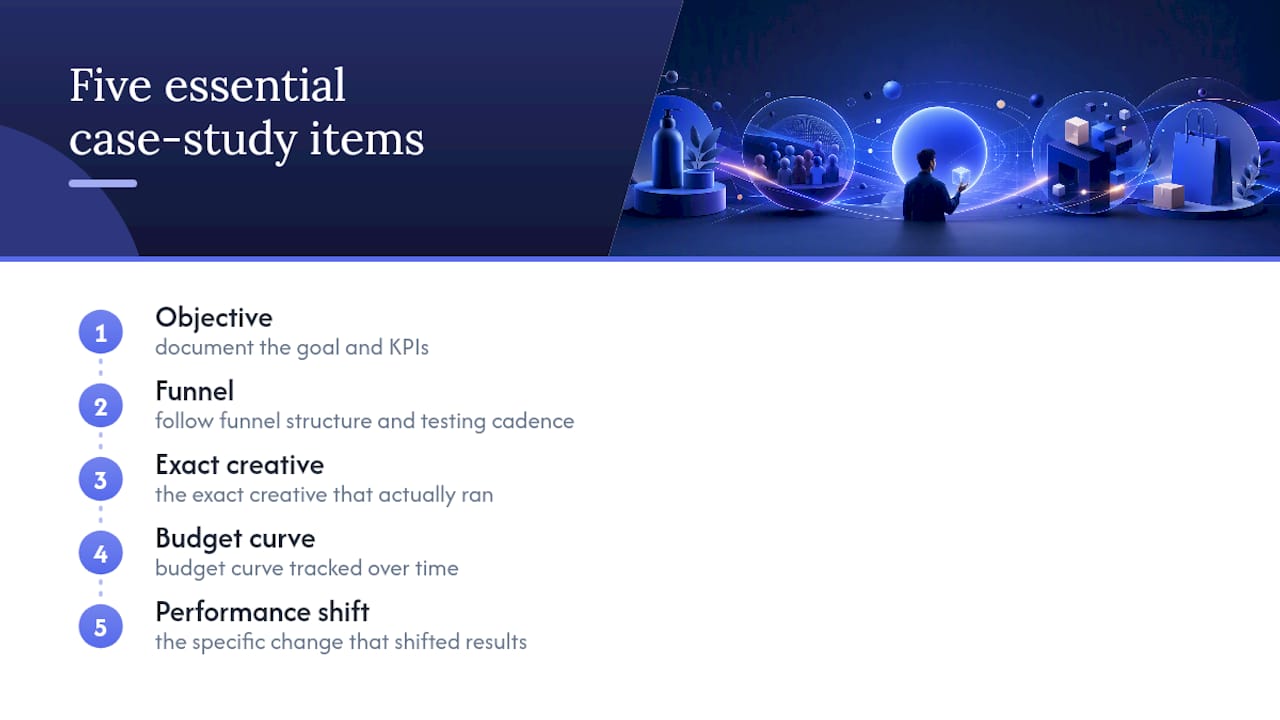
A useful facebook ads case study isn’t a screenshot of a dashboard with a big green number. It documents the objective, the funnel, the exact creative that ran, the budget curve over time, and the specific change that shifted performance. Most of what circulates online skips three of those five things.
Meta’s own success gallery publishes brand case studies showing meaningful revenue and reach gains, and they’re worth browsing for inspiration. But they rarely show you the messy middle: the angle that flopped for two weeks before the winner emerged, or the exact moment a founder almost killed the campaign. That’s the gap this article fills, using two campaigns built around the same principle: creative decides who sees your ad now, not just how well it converts once seen.
The first case study below covers a mid-size apparel brand scaling from stagnant to profitable. The second covers a smaller supplement brand launching cold with a tight budget. Both follow the funnel structure and testing cadence I use with brands at Cosma, and both reflect how Meta’s Andromeda retrieval model changed what “good targeting” even means.
Case Study 1: Scaling a Stalled Apparel Brand From $9K to $61K Monthly Revenue
The brand: a direct-to-consumer apparel label doing about $40,000 a month in mostly organic and email revenue, with Facebook ads stuck at a 1.3 return on ad spend. Their objective wasn’t awareness.
The setup:
- Funnel: cold traffic to a product collection page (not a single hero SKU), warm retargeting to abandoned cart and add-to-cart audiences
- Ad formats: three short-form video hooks under 15 seconds, one carousel showcasing five best-sellers, two UGC-style testimonial clips
- Budget: started at $150 per day across four ad sets, scaled to $650 per day by week six
- Timeline: 90-day sprint, with the first two weeks dedicated purely to creative testing before any scaling decisions
The turning point wasn’t a targeting tweak. It was swapping polished studio product shots for a UGC video where a real customer described the fabric feel in her own words, filmed on her phone. That single creative outperformed every studio asset by a wide margin on cost per purchase, and it became the seed for four spinoff angles tested over the following month.
Results after 90 days: revenue grew from roughly $9,000 to $61,000 in monthly paid-attributed sales, blended ROAS moved from 1.3 to 3.8, and cost per acquisition dropped by more than half.
The account never used more than six active ad sets at once. Instead of fragmenting budget across narrow interests, we consolidated into two broad cold campaigns and let Meta’s delivery system do the audience work, a shift consistent with what Sprout Social’s 2026 ad examples found when brands tested Advantage+ style delivery against manually segmented sets.
Case Study 2: A $28-a-Day Cold Launch That Hit 4.1x ROAS in Three Weeks
Not every winning account has a five-figure monthly budget. A supplement brand launched cold with $28 a day, split across two ad sets, because the founder wanted proof before committing more spend. The structure had to differ from the apparel case because there was no retargeting pool yet. Everything ran cold from day one.
What was different:
- Audience: broad, no interest layering, one small lookalike seeded from an email list of 1,200 past customers
- Creative: a single 22-second video shot on an iPhone, no paid actor, founder explaining the product’s origin story directly to camera
- Bidding: lowest-cost with no cap for the first ten days to let the algorithm find its footing, then a cost cap introduced once purchase volume stabilized
- Offer: a bundle discount on the landing page rather than a discount in the ad copy itself, keeping the ad focused on the story
Small-budget accounts like this one succeed most often when the offer and the creative match the audience tightly, since there’s no room for the algorithm to average out a weak asset against a strong one the way a bigger budget allows.
Results after three weeks: cost per purchase fell from $34 in week one to $14 by week three, and blended ROAS reached 4.1x on a total spend under $600.
The playbook to copy here isn’t the budget size. It’s the sequencing: one creative, one clear story, patience through the first week of learning-phase noise before touching the budget at all. That patience is usually the hardest part for a founder watching daily numbers.
How Do You Set Up a Campaign to Reproduce These Results?
Both accounts above followed the same underlying structure, and it maps to Meta’s 2026 Performance 5 guidance almost exactly.
- Pick one objective and one KPI. Purchase-optimized campaigns need a clear cost-per-purchase or ROAS target set before launch, not after the first week of data.
- Choose your structure based on volume. Accounts averaging 50 or more purchases a week generally do better on Advantage+ Shopping Campaigns; below that threshold, a controlled 6-3-1 structure (six ad sets, three creatives each, one campaign) keeps enough signal concentrated to actually learn.
- Install Conversions API alongside the Pixel. Server-side tracking recovers events the browser pixel misses and improves Event Match Quality, which directly affects how cheaply Meta can find buyers.
- Respect the learning phase. Each ad set needs roughly 50 conversion events before Meta’s algorithm stabilizes delivery; pulling budget or editing an ad set mid-phase resets that clock.
Pro Tip: Don’t judge a new campaign before day four. The first 72 hours are almost always noisy, and founders who panic-edit during that window are usually the ones who never get a stable read.
What Creative Strategy Actually Drove These Wins?
Creative isn’t just the thing people see, it’s the mechanism Meta’s algorithm uses to find them. Under the Andromeda retrieval model, creative reportedly drives an estimated 50 to 60 percent of ad performance outcomes, which flips the old logic where targeting did most of the heavy lifting.
Four angle types repeated across both case studies above:
- Direct statement: “This is what the product does,” shown plainly, no gimmicks.
- Result or efficiency angle: the specific outcome a customer got and how fast.
- POV or personal story: a founder or customer speaking directly to camera, unscripted feel.
- Contrarian angle: challenging an assumption the buyer already holds about the category.
On format, short-form video with a hook inside the first three seconds and UGC-style social proof consistently improved click-through and early conversion in both accounts. Static and carousel still have a place, particularly for retargeting, but they rarely carried cold traffic on their own.
Accounts spending at real scale typically need multiple new creatives per month to stay ahead of fatigue. My ecommerce Meta Ads playbook covers how we brief that volume without burning out a creative team.
Pro Tip: Read ten competitor or adjacent-niche ads before you brief a single new creative. Most winning angles are adaptations of something already working elsewhere, not inventions.
How Should You Structure Cold vs Warm Audiences?
Broad targeting is the default I recommend for most ecommerce accounts with a functioning pixel and steady purchase volume, since over-fragmenting ad sets starves each one of the signal it needs to optimize.
- Seed an Advantage+ Audience with a customer list or lookalike, then let delivery expand from there rather than manually stacking interests.
- Always exclude recent purchasers and existing customers from cold prospecting campaigns to avoid wasting spend on people who already converted.
- Segment warm audiences by intent: cart abandoners get urgency-driven copy, product viewers get social proof, past purchasers get replenishment or cross-sell messaging.
- First-party lists work best when refreshed monthly. A six-month-old customer list is a weak lookalike seed compared to one updated weekly.
How Do You Know the ROAS Numbers Are Real?
Ads Manager and your bank account rarely agree, and reconciling them is where a lot of case studies fall apart under scrutiny.
- Conversions API paired with a high Event Match Quality score closes the gap between what the browser pixel sees and what actually happened at checkout.
- Attribution windows change the story: a 7-day click model reports differently than a 1-day click, sometimes by a wide margin on the same spend.
- Reconcile weekly against Shopify or your CRM’s actual revenue, not just Ads Manager’s self-reported number.
- The most common tracking mistake is comparing platform-reported ROAS from one attribution setting against a blended ROAS calculated from total revenue. They are not the same metric.
Both case studies above used 7-day click, 1-day view attribution, reconciled weekly against actual store revenue, a setup detailed further in my Facebook Ads audit guide.
When Should You Scale a Winning Ad?
- Test one variable per iteration. Change the hook, or the format, or the offer, never all three in the same test.
- Wait for at least 50 conversion events before calling a winner, per ad set.
- Promote winners into a dedicated scaling campaign rather than just raising budget on the original testing ad set.
- Increase budget in 20 to 30 percent increments every three to four days, not overnight doublings that reset learning.
- Watch frequency and CTR for early fatigue signals, and rotate in new creative before performance visibly drops, not after.
Pro Tip: Budget your creative production, not just your media spend. A brand spending $10,000 a month on ads but producing two creatives a quarter is under-resourced no matter how good the media buying is. My guide on scaling without wrecking ROAS goes deeper on pacing.
What I Check Before Launching Any DTC Meta Campaign
Every account I look at gets the same short list of questions before we touch a media budget:
- Is Conversions API installed and is Event Match Quality above 6? If not, fix that before touching creative or targeting.
- Do we have at least three genuinely distinct creative angles ready, not three versions of the same hook?
- Is the account doing 50 or more weekly purchases? If yes, Advantage+ Shopping gets tested first. If no, a controlled 6-3-1 structure runs instead.
- Are exclusions set up so cold budget never touches existing customers?
The trade-off I weigh most often is creative volume against control: more creatives mean faster signal but harder attribution of exactly what worked. I’d rather test three sharp angles cleanly than twelve mediocre ones simultaneously. You can see how this plays out across different brand categories in Cosma’s case studies, and the creative work behind those results is in our portfolio.
The Part Most Case Studies Leave Out
Most published case studies sell you the outcome and skip the discomfort that produced it. Both campaigns above had a week where performance looked worse before it looked better, and in both cases the instinct to intervene early would have killed the eventual winner. That’s the part conventional advice glosses over: patience through the learning phase isn’t a nice idea, it’s a mechanical requirement of how Meta’s delivery system works.
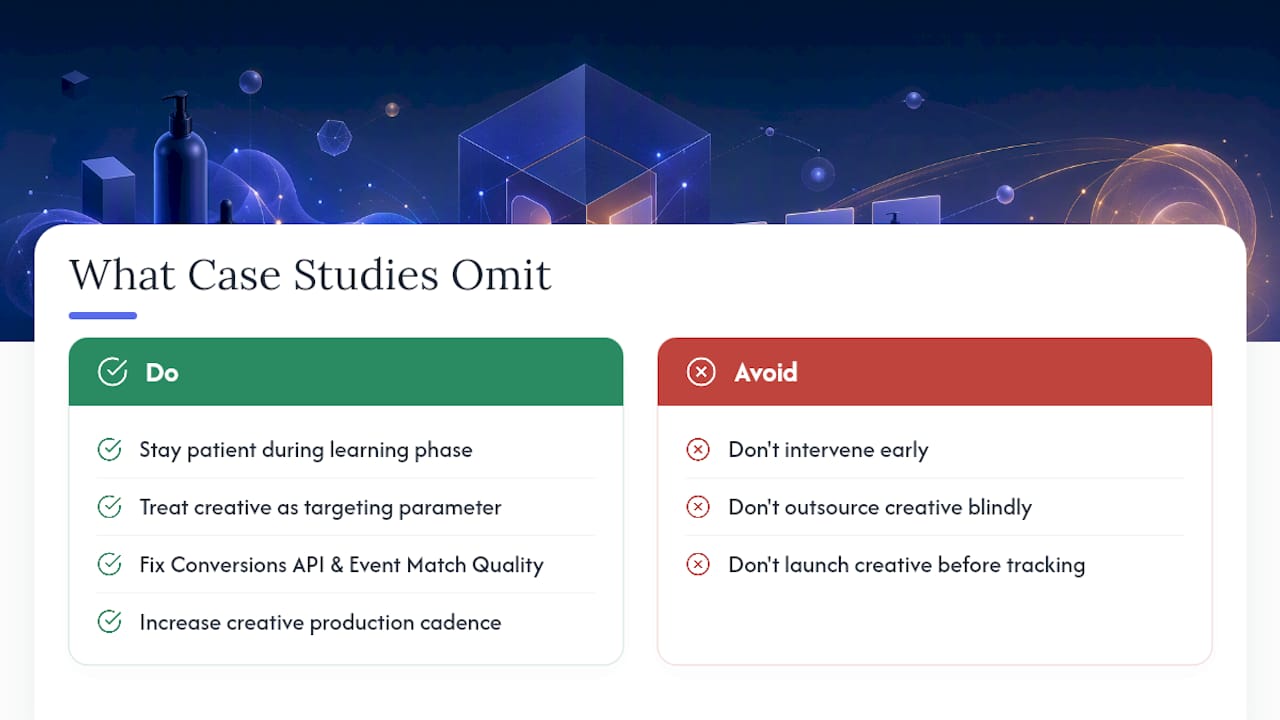
The bigger miss in most Facebook advertising strategy content is treating creative and targeting as separate disciplines. They aren’t anymore. Under Andromeda, your creative angle functions as a targeting parameter, so a founder who outsources creative to a freelancer with no visibility into performance data is handicapping the account before the media buying even starts. If I had to pick one lever most DTC brands underinvest in, it’s creative production cadence, not budget size.
What I’d prioritize first for any brand reading this: get Conversions API and Event Match Quality right before spending another dollar on new creative. A great ad on bad tracking data will get killed by an algorithm that can’t see it converting.
— Stefano Mazzei
How My Team at Cosma Can Help You Run This Playbook
Everything above is reproducible, but reproducing it under a live budget with real deadlines is a different job than reading about it. My team at Cosma runs Meta Ads strategy, creative testing, and scaling for DTC and ecommerce brands across the US and Canada, and the campaign structures in this article come directly from accounts we manage.

If you’re deciding whether to rebuild your account structure, fix a tracking gap, or just get a second opinion on why ROAS has stalled, a diagnostic conversation is the fastest way to find out where the leak is. We’ll look at your account structure, your Event Match Quality, and your current creative output against the benchmarks in this article. You can see the kind of creative work we produce in our portfolio or browse recent case studies for outcomes across different verticals. When you’re ready, book a call and we’ll walk through your account together.
Sources
For deeper detail beyond this article, Meta’s own success gallery catalogs brand case studies directly. HubSpot’s 2026 strategy guide and Sprout Social’s ad examples roundup cover format and funnel best practices in more depth than space allows here.
- Find Inspiring Brand Success Stories | Meta for Business
- 12 Facebook ad examples and why they work | Sprout Social
- Facebook Ads Strategy: The 2026 Framework (+ Real Examples)
- Facebook Ads Best Practices: The 2026 Expert Playbook | AdAdvisor
FAQ
Is $10 a Day Enough for Facebook Ads?
It can generate initial data, but $10 a day rarely produces enough conversion events to exit the learning phase quickly. Most accounts need closer to $20 to $30 a day minimum to gather the roughly 50 conversion events per ad set that stabilize Meta’s delivery algorithm.
Is $1,000 Enough for Facebook Ads?
Yes, a modest budget can fund a legitimate test, especially spread over two to three weeks rather than spent in a few days.
What Are Some Good Examples of Facebook Ads?
Short-form video with a hook in the first three seconds, UGC-style testimonials filmed on a phone, and founder-led personal story videos consistently outperformed polished studio creative in the case studies above.
What Are Some Effective Case Studies for Advertising?
The most useful ones document exact spend, timeline, creative assets, and the specific optimization that changed results, rather than just a final revenue number. Meta’s official success gallery is a good starting point for browsing verified brand outcomes.
How Long Does It Take to See Results From Facebook Ads?
Expect the first one to two weeks to be primarily creative testing with noisy data, and meaningful optimization decisions to start around week three once ad sets have cleared the learning phase. Both case studies here showed their major performance shift between week three and week six.


