
Make Blended CAC Board Ready: Reconcile 4 Sources for SaaS & Ecommerce
Blended CAC is total sales and marketing spend divided by every new customer you acquired in the same period, full stop, no channel carve outs. I lean on it more than any other acquisition metric because it is the one number a CFO and a growth lead can agree on without arguing about attribution models. It pairs directly with LTV:CAC and payback period to tell you whether your growth is actually profitable.
TL;DR:
- Blended CAC should be calculated consistently using fully-loaded costs to accurately reflect true acquisition expenses.
- Using unique first-time customer counts from your order system prevents double-counting and inflating your CAC.
- Regular reconciliation of spend data and new customer counts monthly ensures your CAC remains trustworthy for strategic decisions.
- Comparing blended CAC to LTV and payback periods reveals whether your growth is profitable or requires operational adjustments.
- Focusing on improving retention and order value has a greater long-term impact on CAC efficiency than just lowering acquisition costs.
Table of Contents
- What Is Blended CAC and How Do You Calculate It?
- What Counts in the Numerator and Denominator?
- Reading Blended CAC Against LTV:CAC, Payback, and MER
- A Worked Example and the Traps That Break It
- Levers That Actually Move Blended CAC
- How I Use Blended CAC in Client Engagements at Cosma
- Where to Go Deeper on Blended CAC
- My Take: Stop Treating Blended CAC as a Vanity Number
- Sources
- FAQ
What Is Blended CAC and How Do You Calculate It?
The formula is simple: total sales and marketing spend divided by new customers acquired in that same window. What makes blended CAC different from a channel report is the scope of the numerator, and that scope is a choice you have to make deliberately.
You can run it two ways. A strict version counts only paid media spend, which is fast to pull but understates true cost. A fully-loaded version adds agency retainers, creative production, tools, and the salaries of people whose job is acquisition, which AdSights defines as the more honest read of what growth actually costs you.
Here’s a quick example:
- Total spend for the month: $80,000 in paid media plus $15,000 in agency fees and creative production, for $95,000 fully-loaded.
- New customers acquired: 950 unique first-time buyers, confirmed against your order system.
- Blended CAC: $95,000 divided by 950 equals $100 per customer.
That $100 is the number I show clients, not the platform-reported average, because Karbon Analytics frames blended CAC as best calculated from reconciled spend and order data rather than dashboard exports.
What Counts in the Numerator and Denominator?
Most blended CAC errors trace back to one of two things: sloppy spend scope or a denominator that double-counts. Fix both and the number becomes trustworthy enough to put in front of a board.
Include in your numerator:
- Paid media spend across every channel (Meta, Google, TikTok, affiliate networks)
- Creative production costs, including UGC and photography
- Agency retainers and freelance acquisition support
- Influencer and affiliate payouts tied to new-customer acquisition
- Salaries for staff whose primary function is acquisition (not retention)
- Marketing tools and software used for prospecting or campaign management
Exclude retention flows, fulfillment costs, customer service, and general overhead unrelated to acquisition. Whichever scope you pick, strict or fully-loaded, apply it the same way every month. A number that swings because you added agency fees in March and dropped them in April is worse than no number at all.
The denominator has its own trap: it must be unique first-time customers, not orders and not platform-reported “new customer” counts summed across channels. UseDayMark’s analysis points out that summing platform-reported customers routinely understates true CAC because the same buyer gets claimed as “new” by two or three platforms simultaneously.
Pro Tip: Tag every order with a first-purchase flag in your CRM or Shopify backend, then reconcile that flag against your ad platforms monthly. If the platform-summed new-customer count exceeds your CRM count by more than a few percent, you have overlapping attribution to sort out before you trust any CAC number.
Reading Blended CAC Against LTV:CAC, Payback, and MER
A blended CAC number means nothing on its own. It only becomes useful once you put it next to lifetime value and payback period, because a $100 CAC is fantastic for a $600 LTV product and disastrous for a $150 one.
- LTV:CAC ratio: divide customer lifetime value by blended CAC. A commonly cited healthy target is around 3:1, though that varies heavily by margin structure and how Fairview’s benchmarking guidance frames it across different business models.
- Payback period: divide blended CAC by monthly contribution margin per customer. A $100 CAC against $40 in monthly contribution margin gives you a two-and-a-half-month payback, which matters enormously for cash flow if you are reinvesting revenue into growth.
- MER (marketing efficiency ratio): total revenue divided by total spend. Use MER when you want a fast pulse check on revenue efficiency; use blended CAC when you need actual unit economics tied to customer count.
Short payback periods give you room to scale spend aggressively without starving cash flow. Long payback periods force more caution, even when the LTV:CAC ratio looks healthy on paper, because the cash is tied up for longer before it comes back.
A Worked Example and the Traps That Break It
Walking through the full chain catches errors that a single formula misses. Here is the sequence I run with clients before trusting any output number.
- Break down spend. Paid media, agency fees, creative costs, and acquisition salaries, summed into one total for the period.
- Count new customers. Pull unique first-time buyers from your commerce system, not from ad platform dashboards.
- Divide to get blended CAC. Total spend over new customers, as shown in the earlier $100 example.
- Layer in LTV:CAC and payback. Compare that $100 against lifetime value and monthly contribution margin to see if the number is actually good.
Three traps break this every time. First, summing individual platform CACs instead of using one reconciled spend total, which inflates or deflates the real number depending on overlap. Second, counting repeat orders in your new-customer figure. Third, changing what’s in your numerator mid-period, like adding a new agency fee in month two without adjusting your baseline.
Run a quick reconciliation before you report any figure: pull spend from your accounting ledger, pull new customers from Shopify or your CRM, and diff the two against last month’s numbers. If either source moved more than expected without a clear explanation, chase it down before the number goes to finance.

Levers That Actually Move Blended CAC
Short-term, the fastest lever is creative. Sharper ad creative and tighter landing pages lift conversion rate without touching spend, which drops CAC directly. Reallocating budget away from underperforming channels toward what’s converting does the same thing faster than most teams expect. I’ve written more on the creative testing frameworks that tend to move this number fastest for DTC brands.
Longer-term, the bigger gains come from the denominator side of the business, not the numerator. Raising average order value, improving retention so LTV climbs, and cross-selling all make your existing CAC look better without spending an extra dollar. Renegotiating agency costs and automating your spend-to-order reconciliation also chip away at the fully-loaded number over time.
- Sharpen ad creative and landing page conversion rate first, since it’s the cheapest lever
- Reallocate spend toward channels with proven new-customer efficiency
- Increase LTV through retention and AOV work rather than only chasing lower CAC
- Automate attribution reconciliation so you’re not manually stitching spreadsheets every month
That threshold catches real problems before they show up in a quarterly board deck.*
Fairview recommends tracking blended CAC monthly for operational monitoring and reviewing it quarterly for strategic calls, always alongside channel CAC so you can diagnose what’s actually driving the shift.
How I Use Blended CAC in Client Engagements at Cosma
At Cosma, the first thing I do with a new client is agree on numerator scope before we look at a single dashboard. I default to fully-loaded, including agency fees and creative production, because that’s the number that actually reflects what scaling costs the business.
We reconcile four sources: ad account spend, the accounting ledger, the Shopify or CRM order system for first-time-customer counts, and the email platform for flagging returning versus new revenue. That reconciliation runs monthly, with a lighter weekly check on spend pacing.
Action triggers are simple: if blended CAC moves against LTV:CAC targets for two consecutive months, we pause budget reallocation and go straight to creative diagnostics. Specific before-and-after numbers from client work live in our case studies, since every account’s baseline looks different.
Where to Go Deeper on Blended CAC
For definitions and formula variations, AdSights’ glossary and Karbon Analytics are solid starting points. For broader measurement and reporting frameworks that sit alongside blended CAC, West Valley Digital’s blog covers search and attribution measurement worth cross-referencing. Most reconciliation work happens in whatever ledger and commerce platform you already run, not a specialized calculator.
My Take: Stop Treating Blended CAC as a Vanity Number
Most teams calculate blended CAC once, put it in a slide, and move on. That’s backwards. The number only earns its keep when it’s reconciled monthly against a real ledger and a real order system, and when someone is actually accountable for what moves it.
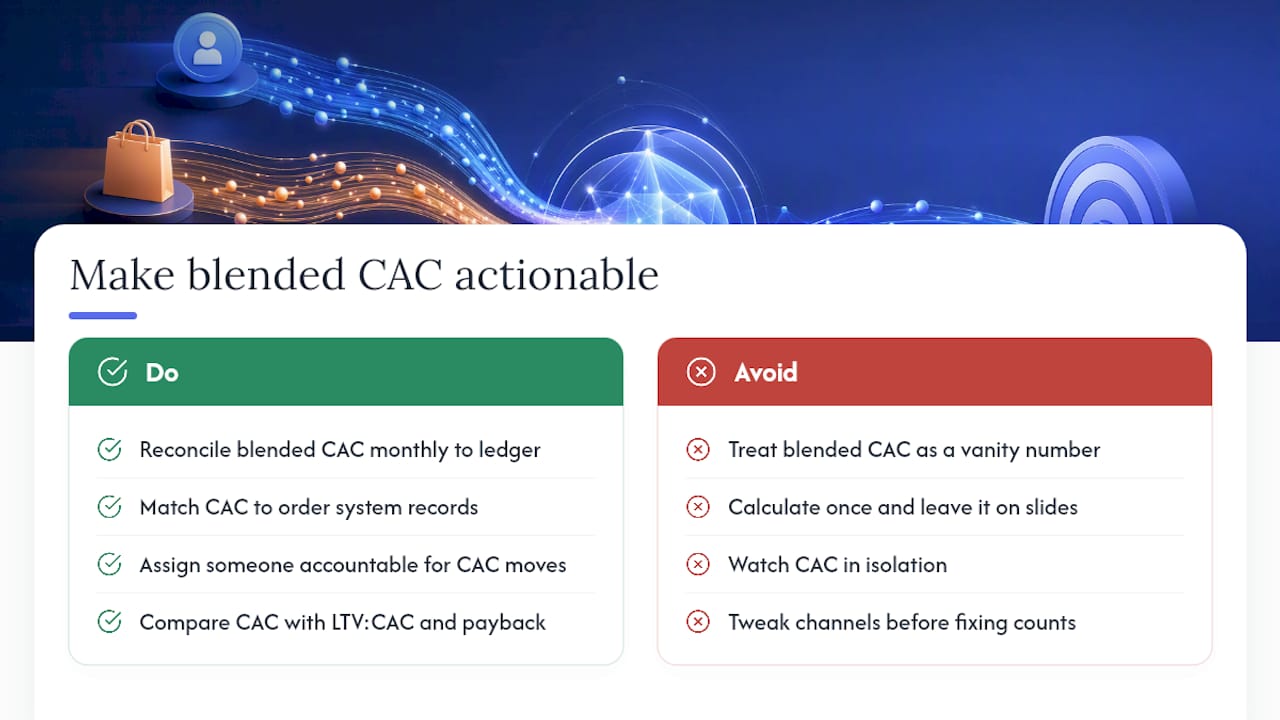
The conventional advice tells you to “watch your CAC.” That’s not specific enough to act on. Watch blended CAC against LTV:CAC and payback period together, because a rising CAC with a rising LTV:CAC ratio is often a sign you’re buying more expensive but more valuable customers, not a problem to panic over.
If I had to pick one place to start: fix your denominator before you touch anything else. A CAC number built on inflated new-customer counts will mislead every decision downstream of it, no matter how good your attribution model looks on paper. Get the reconciliation right first. Everything else, creative testing, channel mix, budget pacing, only matters once the number underneath it is honest.
— Stefano Mazzei
Sources
- What Is Blended CAC? Formula & Benchmarks for Shopify | Karbon Analytics
- Blended customer acquisition cost: Definition & formula | AdSights
- Blended CAC: Formula, What to Include, and Why It Beats Channel CAC | UseDayMark
- Blended CAC: Definition — Fairview
FAQ
What Does CAC Mean in Marketing?
CAC stands for customer acquisition cost, the amount spent to acquire one new customer. Blended CAC specifically covers total spend divided by total new customers across all channels combined, rather than one platform in isolation.
What Is a Good Blended CAC Percentage?
There’s no universal percentage because blended CAC is a dollar figure, not a ratio, and it varies enormously by business model. Judge it against your LTV:CAC ratio and payback period instead, since a 3:1 LTV:CAC guideline is a common reference point, not a fixed rule.
Is CAC a KPI?
Yes, blended CAC is one of the core KPIs for measuring acquisition efficiency because it ties directly to unit economics and cash flow, not just top-line growth.
Are ROAS and CAC the Same Thing?
No. ROAS (return on ad spend) measures revenue generated per dollar spent, while blended CAC measures the cost to acquire one new customer. They answer different questions: ROAS tells you about revenue efficiency, blended CAC tells you about the true cost of growth.