Lower CAC: UGC Creative Strategy for DTC with a 30%+ Hook Rate
A UGC creative strategy is a repeatable system that sources customer-style assets, briefs creators, and runs a structured test, iterate, and scale loop. Done right, it lowers customer acquisition cost and lifts conversion rate, because the creative always feels native to the feed instead of like an ad. This article covers the sourcing mix, the brief template, the testing stages, and the exact metrics I use to judge whether an asset earns more budget.
TL;DR:
- A UGC creative system relies on combining organic, paid, and AI-generated content to produce authentic assets tailored to each funnel stage and audience, reducing reliance on influencers.
- Building a steady pipeline of UGC assets requires focusing on one primary KPI, maintaining a clear sourcing decision tree, and assigning dedicated personnel to manage the feedback loop.
- Short, focused briefs that specify hooks, proof, format, tone, and do-not-dos outperform lengthy scripts and support staged testing to prevent creative fatigue.
- Tracking layered metrics like hook rate, hold rate, and completion rate enables early detection of underperforming assets before ROAS declines.
- Reframing and updating assets for different channels and refreshing paid assets every few weeks maximizes authenticity and prevents fatigue at scale.
Table of Contents
- What Is UGC, and How Is It Different From Influencer Content?
- Where Does Each UGC Format Fit in the Funnel?
- How Do You Build a UGC Engine That Doesn’t Run Out of Assets?
- What Does a Working Creative Brief and Testing Loop Look Like?
- What Rights and Permissions Do You Actually Need?
- Which Metrics Actually Tell You an Asset Is Working?
- How Do You Deploy and Repurpose UGC Without Losing Authenticity?
- What Cadence Actually Works at Scale?
- Why an Engine Mindset Beats a Campaign Mindset
- How My Team at Cosma Builds This for You
- Sources
- FAQ
What Is UGC, and How Is It Different From Influencer Content?
User-generated content is any asset that looks and sounds like it came from a real customer: a phone-shot testimonial, an unboxing clip, a product photo in someone’s kitchen, a candid Q&A response. It differs from influencer content in one key way: UGC is judged on believability, not reach. An influencer post trades on the creator’s existing audience and personal brand. A UGC asset trades on looking like proof, not promotion, whether or not the person posting it has any followers at all.
Three sources feed a working UGC program, and each solves a different problem:
- Organic customer content (reviews, unprompted photos, tagged posts) builds on-site trust and social proof at near-zero cost.
- Paid UGC creators (freelancers hired specifically to produce testimonial-style video) give you controllable hero content and predictable volume.
- AI-assisted generation fills gaps fast for hook testing and ad-creative volume, though it should never replace real customer reviews, which need to stay authentic and unfabricated.
A modern program blends all three rather than betting on one source.
Where Does Each UGC Format Fit in the Funnel?
Match the format to the job the funnel stage needs done. Cold audiences need a reason to stop scrolling. Warm audiences need proof. Existing customers need a reason to come back.
Shopify’s own research on ecommerce conversion found that UGC on product pages, in reviews, and in Q&A sections increases purchase likelihood specifically because it works across every stage of the funnel, not just one.
| Funnel stage | Best UGC format | Typical placement |
|---|---|---|
| Awareness | Short-form hook video, relatable problem/solution skits | Cold Meta/TikTok ads, top-of-feed placements |
| Consideration | Longer testimonial video, side-by-side comparisons | Retargeting ads, landing pages |
| Conversion | Photo reviews, unboxing clips, Q&A snippets | Product detail pages, checkout upsells |
| Retention | Customer spotlight, “how I use it” content | Post-purchase email, SMS, loyalty community |
Awareness-stage video wins on hook strength, not polish. Conversion-stage assets win on specificity: a review that names the exact problem solved beats a generic five-star rating every time.
How Do You Build a UGC Engine That Doesn’t Run Out of Assets?
Ad-hoc UGC dies the moment your best creator stops responding to emails. An engine survives because it doesn’t depend on any single source.
Start with the goal hierarchy. Pick exactly one primary KPI per program, whether that’s cost per acquisition, hook rate, or a specific conversion lift, and let every sourcing decision serve that number. Trying to optimize for five metrics at once is how teams end up with a library full of assets that don’t move anything.
Next, build your sourcing decision tree:
- Need volume fast for hook testing? Use AI-assisted generation or a broad open call to customers with an incentive attached.
- Need a hero asset that will run for months? Hire a paid UGC creator with a tight brief and a usage-rights agreement.
- Need ongoing, low-cost social proof? Activate existing customers through discounts, loyalty points, or a branded hashtag prompt.
- Need to fill an ad account’s daily creative rotation? Combine in-house editing with a rotating pool of two or three reliable creators.
Rewards and simple activation hooks, like a branded hashtag or a packaging prompt asking for a photo, consistently generate steady organic volume when the ask is clear.
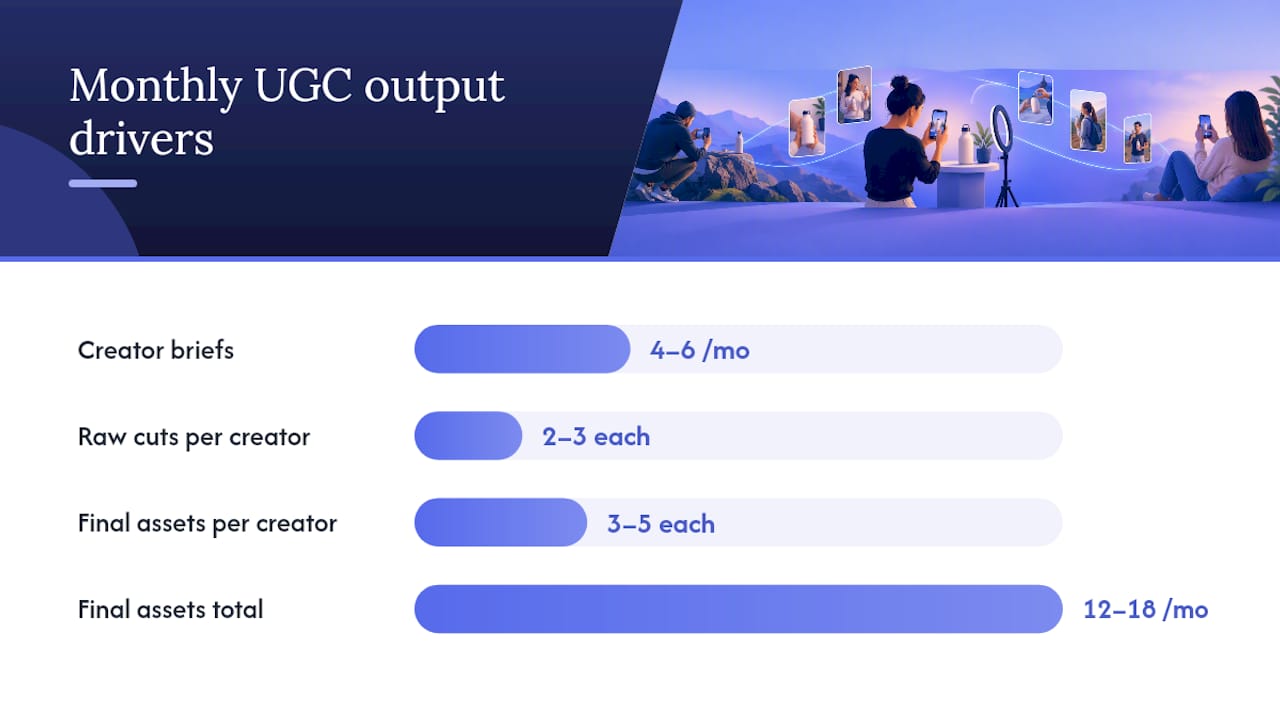
Set your cadence before you set your budget. Scaled DTC accounts typically run four to six creator briefs a month, with each creator delivering two or three raw cuts, which internal editing turns into three to five final assets. That works out to roughly 12 to 18 new final assets per month for an account spending seriously on paid social.
Pro Tip: Assign one person to own the “brief to briefing” feedback loop, even if it’s just an hour a week. The single biggest cause of stale UGC libraries is nobody closing the loop between what performed last month and what gets briefed next month.
What Does a Working Creative Brief and Testing Loop Look Like?
Long scripts kill authenticity. A compact one-page brief that specifies the arc, the hook, and the proof requirement consistently outperforms a five-page shot list, because it leaves room for the creator’s natural delivery.
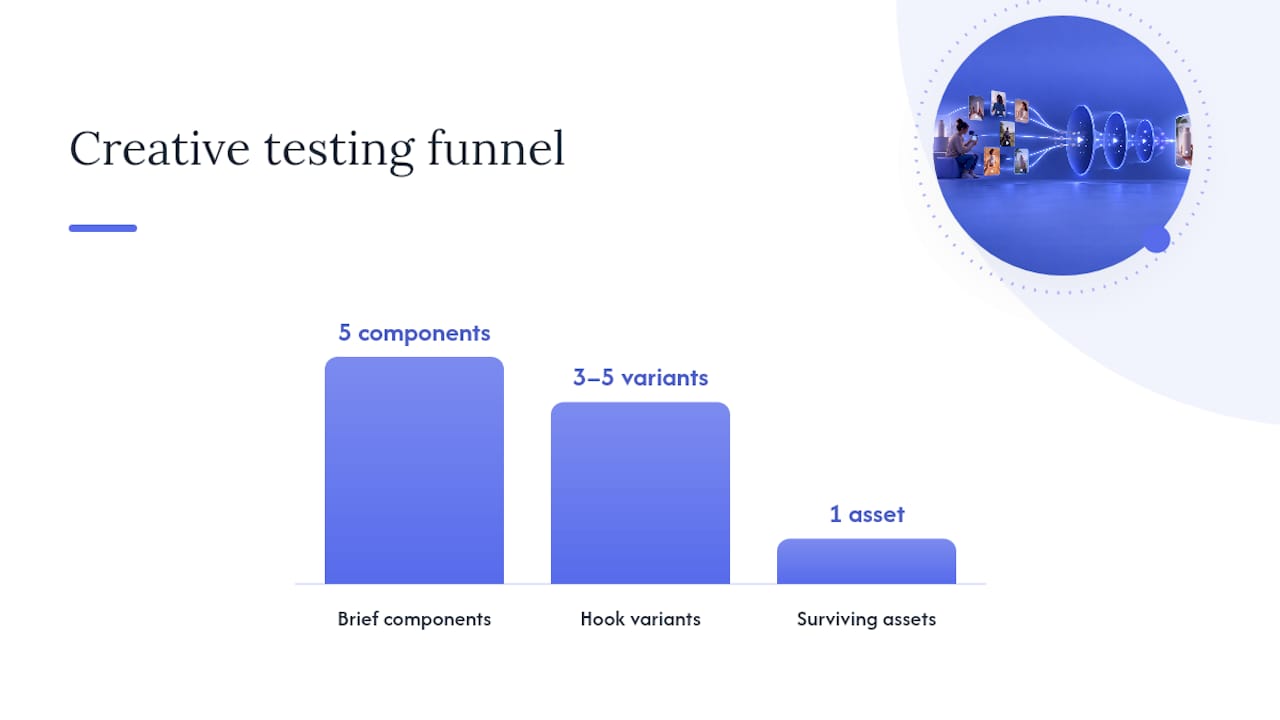
Your brief needs five components:
- Hook hypothesis: the specific line or visual moment meant to stop the scroll in the first two seconds.
- Proof requirement: what the creator must show or say to make the claim credible (a before/after, a specific use case, a direct comparison).
- Format constraints: aspect ratio, length, whether it’s talking-head or demo-style.
- Tone guardrails: how casual, how scripted, what vocabulary fits the brand.
- Do-not-dos: claims that can’t be made, competitors that can’t be named, visuals that clash with brand guidelines.
Once the brief is out, run the test in three stages instead of dumping full budget behind one version.
The hook stage puts three to five variants against a small, cheap audience purely to measure thumb-stop rate. The body stage takes only the hooks that cleared your bar and tests full-length versions against a slightly larger cold audience, watching hold rate and completion. The scale stage takes the surviving asset and pushes real budget behind it while watching for fatigue.
Fatigue shows up as a rising CPA alongside a falling frequency-adjusted hook rate, usually a signal the asset has been in rotation too long relative to your audience size. A layered measurement approach using early signals lets you catch this and refresh the asset with a new hook before performance actually collapses, rather than after.
What Rights and Permissions Do You Actually Need?
Not every use case needs the same paperwork. A repost on your brand’s own Instagram Story from a happy customer is a lighter lift than running that same clip as a paid ad to a million strangers, and treating them the same way either overexposes you legally or slows down your team for no reason.
- Organic repost rights: a simple DM asking “mind if we share this?” with a documented “yes” reply is enough for social reposts, though it is not sufficient for paid use.
- Paid ad usage: requires explicit written consent specifying the channels, the duration, and ideally a renewal clause so you’re not running an expired asset without realizing it.
- Evergreen/owned usage: product page reviews and Q&A generally fall under your platform’s terms of service, but confirm this with whatever review app you’re running.
Written usage rights and a renewal clause matter most for paid use, since that’s where legal exposure is highest. Keep a simple spreadsheet or a rights-tracking tool logging who granted what, for how long, and on which channels, and set a calendar reminder before any renewal clause expires.
Which Metrics Actually Tell You an Asset Is Working?
Judge creative in layers, because ROAS lags behind the signals that predict it. Waiting for ROAS to tell you an asset is bad means you’ve already spent the budget that would’ve told you sooner.
- Hook rate (thumb-stop ratio): the percentage who stop scrolling in the first two to three seconds. A 30%+ hook rate benchmark for cold audiences is a common target for scaled DTC accounts.
- Hold rate (3-second view): how many stay past the hook once they’ve stopped.
- Completion rate: the share who watch to the end, a strong proxy for message clarity.
- Landing page CVR by creative: attach UTM parameters per asset so you can see which creative actually converts, not just which one gets clicks.
- Blended CPA/ROAS: the lagging confirmation metric, useful for validating what the earlier signals already told you.
Layered measurement using hook rate, hold rate, and completion gives you a stop or scale decision days before ROAS is statistically reliable, which is the entire point of testing in stages instead of all at once.
How Do You Deploy and Repurpose UGC Without Losing Authenticity?
Deploy the same asset across organic social, paid ads, product pages, email, and community channels, but resist the urge to just re-upload the exact same file everywhere.
- Reframe the caption and CTA for each channel; a product page needs a direct benefit statement, while an organic post can stay conversational.
- Re-crop for the placement: square or vertical for feed and Stories, horizontal thumbnails for email hero images.
- Swap the thumbnail frame to the most compelling visual moment, not just the first frame of the clip.
- Add captions or alt text for accessibility on every version, since a meaningful share of viewers watch with sound off.
- Refresh paid-channel assets every two to four weeks for cold audiences to stay ahead of fatigue, even when the underlying asset is still converting.
What Cadence Actually Works at Scale?
Working with ecommerce clients at Cosma, I’ve found the accounts that treat UGC as infrastructure, not a campaign, outperform the ones that scramble for content every launch. A steady briefing cadence paired with clear hook-rate benchmarks consistently beats sporadic, high-effort shoots. You can see how this plays out in practice across our case studies and portfolio of creative work.
Why an Engine Mindset Beats a Campaign Mindset
Campaigns expire the moment the offer changes. An engine compounds, because every test feeds the next brief. Leaders who fund UGC as a one-off shoot are budgeting for a moment; leaders who fund it as infrastructure are budgeting for a curve. The single highest-leverage move is a standing weekly review between media buyers and creative producers, nothing more elaborate than that.
— Stefano Mazzei
How My Team at Cosma Builds This for You
Running a real UGC engine, sourcing creators, writing briefs, staging tests, and reading early signals, takes more hours than most in-house teams have free. My team at Cosma builds and manages exactly this system for DTC and ecommerce brands, pairing performance creative with the Meta Ads strategy that puts it in front of the right audience.
We handle the sourcing mix, the brief templates, and the test-to-scale decisions so your team isn’t guessing which asset deserves more budget. If you want to see how this has worked for other ecommerce brands, browse our case studies or our creative portfolio. If you’re ready to talk about your account specifically, book a call with my team and we’ll walk through where your current creative pipeline is leaking performance.
Sources
- User-generated content (UGC) — Shopify blog
- UGC marketing: The 2026 strategy guide (with AI) | ClipLoft
- The Complete Guide to UGC Creative Strategy for DTC Brands in 2026 – D2C Times
FAQ
Is UGC Still Relevant in 2026?
Yes. If anything, it matters more, because feed algorithms increasingly favor content that looks native over content that looks produced. Brands that treat UGC as a system rather than a one-off tactic are the ones still seeing it perform.
What Is a UGC Strategy?
A UGC strategy is a repeatable process for sourcing customer-style content, briefing it correctly, and testing it in stages before scaling budget behind winners. It typically blends organic customers, paid creators, and AI-assisted generation rather than relying on a single source.
Can You Give an Example of a Creative Strategy?
A common example is the hook-body-scale loop: test three to five hook variants on a small cold audience, advance only the winners to full-length body testing, then push real budget behind whatever survives both rounds. This staged approach is core to how top DTC brands brief and test performance creative.
What Is a UGC Side Hustle?
A UGC side hustle refers to individuals getting paid by brands to create testimonial-style content, usually short-form video, without needing an existing audience or influencer status. Brands hire these creators specifically because the content reads as authentic rather than promotional, which is exactly the quality a paid UGC creator is meant to deliver.


