Stop Overspending: Meta Ads Campaign Structure Using ASC And Pixel CAPI
Run three campaigns, not thirty: Advantage+ Shopping, manual prospecting, and retargeting, each with a clear job and its own budget rule. Prospecting runs on Campaign Budget Optimization, retargeting runs on Ad Set Budget Optimization, and neither goes live until your Pixel and Conversions API are both firing clean events. Size every ad set to hit roughly 50 optimization events within seven days, or you’re paying to teach the algorithm nothing.
TL;DR:
- Avoid over-segmentation by limiting ad sets targeting the same audience to prevent learning inefficiencies and wasted spend.
- Maintain clear separation among Advantage+ Shopping, manual prospecting, and retargeting campaigns to prevent audience overlap and bidding against yourself.
- Size each ad set to generate around 50 optimization events within seven days to ensure reliable learning and better performance.
- Use Campaign Budget Optimization for prospecting campaigns and Ad Set Budget Optimization for retargeting to align budget control with campaign goals.
- Confirm Pixel and Conversions API events are firing correctly, with high event match quality, before launching campaigns to ensure accurate measurement and optimization.
Table of Contents
- Why Meta Ads Campaign Structure Starts With Three Levels, Not One
- The Three-Campaign Model: ASC, Manual Prospecting, and Retargeting
- CBO vs. ABO: Which Budget Model Fits Each Campaign
- Building Audiences Without Overlap or Signal Dilution
- How to Test Creative Without Wrecking Your Data
- Why Pixel and CAPI Both Need to Be Working Before You Launch
- Naming Conventions and the Pre-Launch Checklist
- Structuring Campaigns for Lead Gen and App Install Objectives
- How Often You Should Actually Be Checking Your Campaigns
- Budget Pacing: Keeping Spend Steady Without Starving Learning
- What I See Break in Real Accounts
- Get Your Account Structure Audited Before You Scale Spend Further
- Sources
- FAQ
Why Meta Ads Campaign Structure Starts With Three Levels, Not One
Most account audits reveal the same root problem: someone built ad sets before deciding what the campaign was actually for. Meta Ads Manager only gives you three levels to work with, and each one answers a different question.
The campaign level sets your objective and, if you’re using CBO, your budget. This is where you tell Meta what outcome to optimize for and how much money it gets to chase that outcome. Get the objective wrong here (say, picking Traffic when you mean Sales) and everything downstream inherits that mistake.
The ad set level is where audience, placement, bid strategy, and schedule live. This is also the level most vulnerable to churn: change the audience, the placement mix, or the budget by more than a small margin, and you reset the learning phase. Every reset means burning fresh spend just to relearn what the algorithm already knew yesterday.
The ad level is creative only, headlines, images, video, copy, and this is the good news. Swapping creative inside an existing ad set typically doesn’t reset learning the way structural ad set changes do. That’s why ad-level testing should be where most of your iteration happens, not campaign or ad set restructuring.
A few rules follow directly from this hierarchy:
- Decide your objective and budget model at the campaign level and leave it alone once it’s stable.
- Lock audience and placement decisions at the ad set level and treat edits there as expensive.
- Push creative variation to the ad level, where testing is cheap and learning stays intact.
- Never mix funnel stages inside one ad set. Cold and warm traffic behave differently, and blending them muddies the signal Meta needs to optimize.
Understanding which decisions belong where is the single biggest lever for building a Meta ads account structure that doesn’t fight itself.
The Three-Campaign Model: ASC, Manual Prospecting, and Retargeting
For most DTC ecommerce accounts I work on, three campaigns cover the entire funnel: Advantage+ Shopping Campaigns (ASC), manual prospecting, and retargeting. This isn’t a theoretical framework. It’s the architecture practitioners are converging on in 2026, and it works because each campaign has one job and doesn’t compete with the others for the same audience.
- Advantage+ Shopping runs automated prospecting at scale. Meta’s targeting, placement, and creative delivery decisions happen inside a largely automated shell. ASC tends to perform well on large catalogs with strong Conversions API signal, but treat it as its own test cell rather than a replacement for manual work. Feed it your full catalog and let Meta’s own logic find buyers you might not have targeted manually.
- Manual prospecting keeps you in control of interest and lookalike targeting. This is where you test specific audience hypotheses ASC can’t isolate for you, a lookalike built off high-value purchasers, or an interest stack tied to a specific product angle.
- Retargeting re-engages people who’ve already shown intent. Site visitors, add-to-carts, video viewers, past purchasers. This campaign usually carries the highest return on ad spend in the account because you’re talking to warm demand, not creating it.
Budget allocation depends on account maturity, but a commonly recommended split for a scaling DTC brand prioritizes the bulk of spend on ASC, with substantial portions allocated to manual prospecting and retargeting accordingly. As ASC data accumulates and its efficiency holds, shift weight toward it; if manual prospecting is consistently outperforming ASC on a specific product line, move budget the other direction. Let performance decide the split, not a fixed rule you set once and forget.
The part most accounts get wrong is exclusions. If ASC, manual prospecting, and retargeting are all allowed to compete for the same person, you’re bidding against yourself in the auction and diluting the very signal each campaign needs to learn. Exclude existing customers and site visitors from your prospecting campaigns, and exclude your retargeting audience from ASC where the platform allows granular exclusion. The goal is three distinct pools of people, not three campaigns quietly fishing in the same pond.
Pro Tip: Check your Ads Manager overlap reports monthly, not just at launch. Audiences drift as your customer base grows, and a clean exclusion setup in January can quietly develop leaks by June.
CBO vs. ABO: Which Budget Model Fits Each Campaign
Campaign Budget Optimization and Ad Set Budget Optimization aren’t interchangeable, and using the wrong one is one of the fastest ways to waste spend. CBO works well for prospecting at scale, where Meta can shift budget across three to five comparable ad sets to find the best-performing audience automatically. ABO is the better tool for retargeting and structured testing, where you need a guaranteed spend floor on a specific segment regardless of how the algorithm feels about it that week.
The practical rule: if you want Meta making the allocation decision across similar audiences, use CBO. If you need to guarantee a low-volume warm audience (like 60-day cart abandoners) actually gets spent against, use ABO so a bigger ad set in the same campaign doesn’t starve it.
Budget sizing comes down to one number: roughly 50 optimization events per ad set within a seven-day window. That’s the threshold Meta generally needs to exit the learning phase and start optimizing on real data instead of guesswork. Work backward from your expected cost per result. If your typical cost per purchase runs $40, you need roughly $2,000 in weekly spend on that ad set to hit 50 events. If you’re optimizing for add-to-cart instead, at a $5 cost per result, $250 a week gets you there. Setting a daily budget without doing this math first is how accounts stay stuck in perpetual learning limbo.
Scaling from there follows a simple cadence:
- Increase budget in steps of roughly 20% rather than doubling overnight; large jumps reset learning and spike your cost per result temporarily.
- When a winning ad set starts showing unstable delivery or rising costs after several 20% increases, duplicate it into a new ad set instead of pushing the original further.
- Give each budget change 48 to 72 hours to stabilize before judging performance or making another adjustment.
The 50-event threshold isn’t a suggestion buried in Meta’s documentation. It’s the practical difference between an ad set that’s actually learning and one that’s burning your budget on statistical noise.
Building Audiences Without Overlap or Signal Dilution
Your retargeting segments should map to buyer intent, not just to generic time windows. A useful starting structure separates warm traffic into a handful of buckets: 1 to 7 day site visitors (highest intent, shortest window), 8 to 30 day engagers, add-to-cart or checkout-initiated non-purchasers, and past purchasers for cross-sell or replenishment. Each bucket deserves creative that matches where that person actually is, a 1 to 7 day visitor probably needs a direct offer, while a past purchaser responds better to a new-product angle than a repeat of the ad that already converted them.
For prospecting, lookalikes built off a high-value customer seed (not just any purchaser) tend to outperform broad interest targeting once you have enough conversion volume to build them properly. Broad, unconstrained ad sets, ones with no detailed targeting at all, are also worth testing inside your creative test cell, since Meta’s own targeting algorithm often finds pockets of buyers a manual interest list would miss.
None of this works if your audiences overlap. A few checks matter here:
- Run Meta’s Audience Overlap tool between your prospecting and retargeting audiences before launch, not after you notice rising frequency.
- Exclude anyone in a retargeting bucket from every prospecting campaign, including ASC where exclusion controls’ allow it.
- Keep audience sizes proportional to spend. A retargeting audience of 5,000 people can’t efficiently absorb $3,000 a week without frequency climbing fast enough to burn out the creative.
- Refresh lookalike seed audiences quarterly so they reflect your current customer base, not who was buying eighteen months ago.
Get this segmentation wrong and you’re not just wasting spend, you’re actively confusing the algorithm about who your actual customer is.
How to Test Creative Without Wrecking Your Data
Every creative test needs its own dedicated ad set: broad targeting, no exclusions, isolated from your scaling campaigns. Mixing a test into a live prospecting or retargeting ad set means you can’t tell whether a performance shift came from the new creative or from audience drift, and you lose the ability to trust either signal.
- Test one variable at a time. Hook, format, or offer, not all three simultaneously. If you change the opening frame, the background music, and the call to action in the same test, a win tells you nothing about which change caused it.
- Run three to five ads per test cell. Fewer than three doesn’t give the algorithm enough options to differentiate; more than five splits your budget too thin to reach meaningful volume on any single variant.
- Set a minimum impression threshold before judging results, generally a few thousand impressions per ad at minimum, so you’re reading real signal and not a lucky first hour.
- Promote winners into your scaling campaigns only after they’ve cleared your cost-per-result benchmark on real volume, not after a promising first day.
This dedicated test cell approach is standard practice among practitioners building account structures specifically because it isolates creative variables from the audience variables living in your main campaigns.
Creative fatigue is the other half of this. Watch frequency and cost-per-result trend by ad, not just by campaign, since a single fatigued creative can quietly drag campaign-level numbers down while masking a winner sitting right next to it. Most DTC accounts need new creative concepts into the test cell every two to four weeks, faster if you’re spending heavily against a small retargeting pool.
Pro Tip: Log every test hypothesis before you launch it, one line: variable changed, expected outcome. Six months in, that log becomes the fastest way to spot patterns across dozens of tests you’d otherwise forget you ran.
Why Pixel and CAPI Both Need to Be Working Before You Launch
Running the Pixel alone in 2026 is not a measurement strategy. Dual setup, browser Pixel plus server-side Conversions API, is required for accurate measurement after the privacy changes of the past several years stripped away a meaningful share of browser-based tracking.
Before any campaign in this structure goes live, run this checklist:
- Confirm both Pixel and CAPI are firing the same events in the same order, purchase, add-to-cart, initiate checkout, without gaps.
- Set up event deduplication using a matching
event_idon both the browser and server events, so Meta doesn’t double-count a single conversion. - Check your Event Match Quality (EMQ) score in Events Manager for each key event; treat scores meaningfully below Meta’s “good” threshold as a signal something in your customer data (email, phone, name matching) needs fixing before you scale spend.
- Verify your Aggregated Event Measurement priority order reflects your actual funnel priorities, purchase above add-to-cart, not the platform default.
Low EMQ doesn’t just look bad on a dashboard. It skews optimization by starving Meta of the match confidence it needs to find more of your actual buyers, which means your algorithm ends up optimizing against a fuzzier picture of who converts. EMQ and deduplication are practical levers advertisers can pull to recover usable signal, often faster than a creative overhaul will.
If EMQ is weak, fix your customer data collection first: capture more matchable fields at checkout, confirm your CAPI integration is passing hashed email and phone, and only then start troubleshooting audience or creative performance. Chasing creative fixes on top of broken measurement is solving the wrong problem.
Naming Conventions and the Pre-Launch Checklist
A naming pattern only works if everyone on the team can read a campaign’s purpose without opening it. A structure like [Funnel Stage]_[Campaign Type]_[Audience]_[Date], for example PROS_ASC_Catalog_All_0126 or RTG_ABO_Cart7Day_0126, lets anyone scan Ads Manager and know instantly what they’re looking at. Consistency here matters more than the exact format you pick.
Once campaigns are live, check these metrics on a set cadence rather than randomly refreshing the dashboard:
- Days 1 to 3: delivery and spend pacing only, don’t judge cost per result yet.
- Days 4 to 7: frequency, cost per result trend, and whether the ad set is tracking toward its 50-event threshold.
- Days 7 to 14: stabilized return on ad spend, audience overlap check, and creative fatigue signals by ad.
A pre-launch audit catches most structural failures before they cost you money:
- Confirm objective matches the campaign’s actual funnel stage.
- Verify exclusions are in place between prospecting and retargeting.
- Check budget is sized to reach 50 optimization events within seven days.
- Confirm Pixel and CAPI events match and EMQ is within an acceptable range.
- Review naming conventions against your existing account standard before publishing.
Skipping this five-minute audit is how accounts end up bleeding spend for two weeks before anyone notices the retargeting campaign was never excluded from prospecting.
Structuring Campaigns for Lead Gen and App Install Objectives
Everything above assumes an ecommerce purchase objective, but the same three-tier logic (campaign sets goal and budget, ad set carries audience, ad carries creative) holds for other business models with a few adjustments.
For lead generation, your “prospecting” campaign typically optimizes toward Leads or Instant Forms rather than Purchase, and your event volume for the learning phase comes from form completions, not sales. Because lead volume per dollar is often higher than purchase volume, hitting the 50-event threshold usually takes less budget than an ecommerce prospecting campaign at the same spend level. Retargeting still applies, people who started a form but didn’t finish, or downloaded a lead magnet without booking a call, and deserves its own ABO campaign with tailored creative addressing the specific drop-off point.
For app installs, the objective shifts to App Promotion, and your optimization event usually moves further down funnel, from install toward a specific in-app action like registration or first purchase, once you have enough volume to support it. The same exclusion logic applies: exclude existing app users from acquisition campaigns, and build a separate re-engagement campaign for lapsed users.
The core discipline doesn’t change across objectives. Keep campaign-level decisions about goal and budget separate from ad set audience decisions, and isolate creative testing regardless of whether you’re chasing a purchase, a lead, or an install.
How Often You Should Actually Be Checking Your Campaigns
Checking Ads Manager three times a day and making changes each time is one of the fastest ways to sabotage your own learning phase. A more disciplined cadence looks like a daily pacing glance (spend and delivery only), a deeper performance review every three to four days once ad sets have cleared initial learning, and a full account-level audit every two weeks covering overlap, frequency, and creative fatigue.
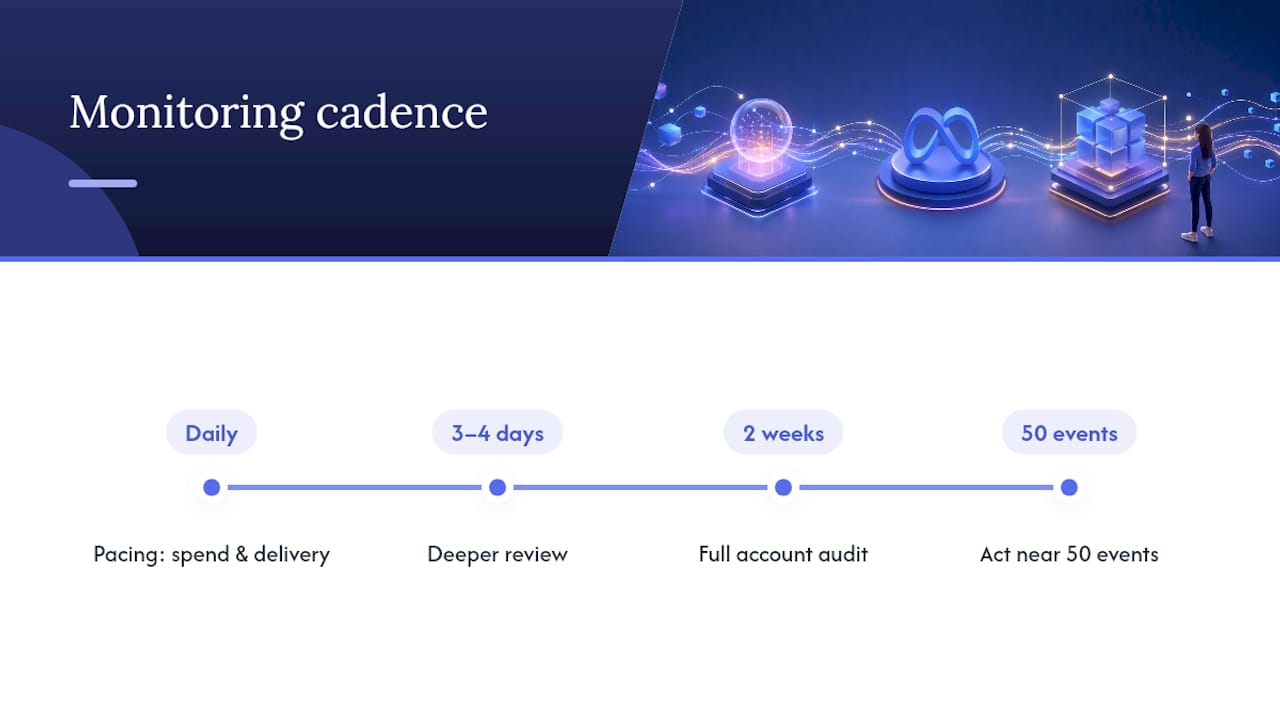
Optimization decisions, pausing an ad, adjusting a budget, adding an exclusion, should be based on statistically meaningful volume, not a bad morning. An ad set that’s spent $50 against a $40 cost-per-purchase target hasn’t failed; it hasn’t had a chance to succeed yet. Wait until you’re within reach of that 50-event threshold before making a call.
The other habit worth building: separate the “watch” cadence from the “act” cadence. You can look at a dashboard daily without touching anything. This single discipline prevents more wasted spend than any targeting tweak I’ve seen an account make.
Budget Pacing: Keeping Spend Steady Without Starving Learning
Meta paces budget across a day or a campaign lifetime depending on whether you’ve set a daily or lifetime budget, and understanding that pacing logic matters more once you’re running three campaigns with different jobs. A daily budget gives you more control for prospecting campaigns where you want steady, predictable spend feeding the learning phase. A lifetime budget can work for time-bound retargeting pushes, a holiday cart-recovery push, for example, where Meta has flexibility to spend more on stronger days within the flight.
Uneven pacing, spend spiking early in the day and starving late, is often a sign your bid strategy is too aggressive relative to available inventory, or that your audience is too small to absorb the budget you’ve assigned it. Watch for a campaign consistently underspending its daily budget: that’s usually an audience-size or bid-cap problem, not a creative problem.
When you scale a budget by the recommended 20% increments, give the pacing a full 48 to 72 hours to normalize before reading results. Spend management within this three-campaign structure comes down to matching each campaign’s budget model, CBO for prospecting’s need to shift dollars across ad sets, ABO for retargeting’s need to guarantee floor spend, to how that campaign actually needs to behave in the auction.
What I See Break in Real Accounts
The failure pattern I run into most often isn’t a bad creative. It’s over-segmentation: ten ad sets targeting slices of the same audience, each one starved for volume and stuck in permanent learning. The second most common issue is mixing funnel stages, retargeting warm cart-abandoners inside the same ad set as cold prospecting traffic, which confuses the algorithm about who it’s actually optimizing toward.
When I audit an account, the triage is always the same order: check exclusions first, then measurement (Pixel, CAPI, EMQ), then budget sizing against the 50-event threshold, and only then touch creative. Structural fixes at Cosma consistently move faster than creative overhauls, because you’re not asking the algorithm to work around a broken foundation anymore.
Most operators reach for a new ad before they reach for their account structure. That’s backwards. Fix the plumbing first.
— Stefano Mazzei
Get Your Account Structure Audited Before You Scale Spend Further
A DIY rebuild using this framework works for accounts still under a few thousand dollars a month in spend, where the cost of a mistake is small and there’s time to iterate. Past that point, the cost of a misconfigured exclusion or a weak EMQ score compounds fast, every dollar you scale into a broken structure is a dollar reinforcing the wrong signal.

That’s the gap I close. I run structural audits, rebuild account architecture around the three-campaign model, manage the CAPI and EMQ setup issues many accounts face, and handle ongoing creative testing so winners get identified and scaled without guesswork. If you’re already running six figures a month and still fighting instability, an audit usually surfaces the fix faster than another round of creative testing will. You can see how this has played out for other DTC brands in our case studies, browse examples of the creative testing process in our portfolio, or book a call with my team to get your current structure looked at directly.
Sources
For the canonical definitions behind everything covered here, Meta’s own documentation remains the reference point, and a couple of practitioner guides fill in the 2026-specific tactics that platform documentation doesn’t cover.
- What are the advertising levels in Meta Ads Manager?
- The Complete Guide to Facebook Ads Campaign Structure in 2026
- How to Structure Meta Ad Campaigns: A Practitioner’s Blueprint for 2026
FAQ
What Is the Best Structure for a Meta Ads Campaign?
For most scaling ecommerce accounts, the best structure is a three-campaign model: Advantage+ Shopping for automated prospecting, a manual prospecting campaign for targeted testing, and a dedicated retargeting campaign for warm audiences. This three-campaign approach keeps each audience pool distinct and prevents campaigns from competing against each other in the auction.
How Are Meta Ads Structured?
Meta Ads are organized into three levels: campaign, ad set, and ad. The campaign level sets the objective and budget, the ad set level controls audience, placement, and schedule, and the ad level holds the actual creative.
What Is the Structure of a Facebook Ad Campaign?
A Facebook ad campaign sits at the top of the three-level hierarchy and determines the objective (like Sales or Leads) and, if using Campaign Budget Optimization, the overall budget. Beneath it, one or more ad sets define who sees the ads, and each ad set contains the individual ads themselves.
Is $10 a Day Enough for Facebook Ads?
For most ecommerce accounts, a low daily budget is rarely enough to reach the roughly 50 optimization events needed within seven days to exit the learning phase. At a $40 cost per purchase, that budget produces less than two conversions a day, far short of what the algorithm needs to optimize reliably.
Should I Use CBO or ABO for a New Meta Ads Account?
New accounts typically do better starting with ABO on a small number of ad sets so each one gets a guaranteed budget floor while you gather initial data. Once you have enough conversion history and want Meta to shift budget automatically across similar audiences, CBO becomes the better fit for scaling prospecting.


